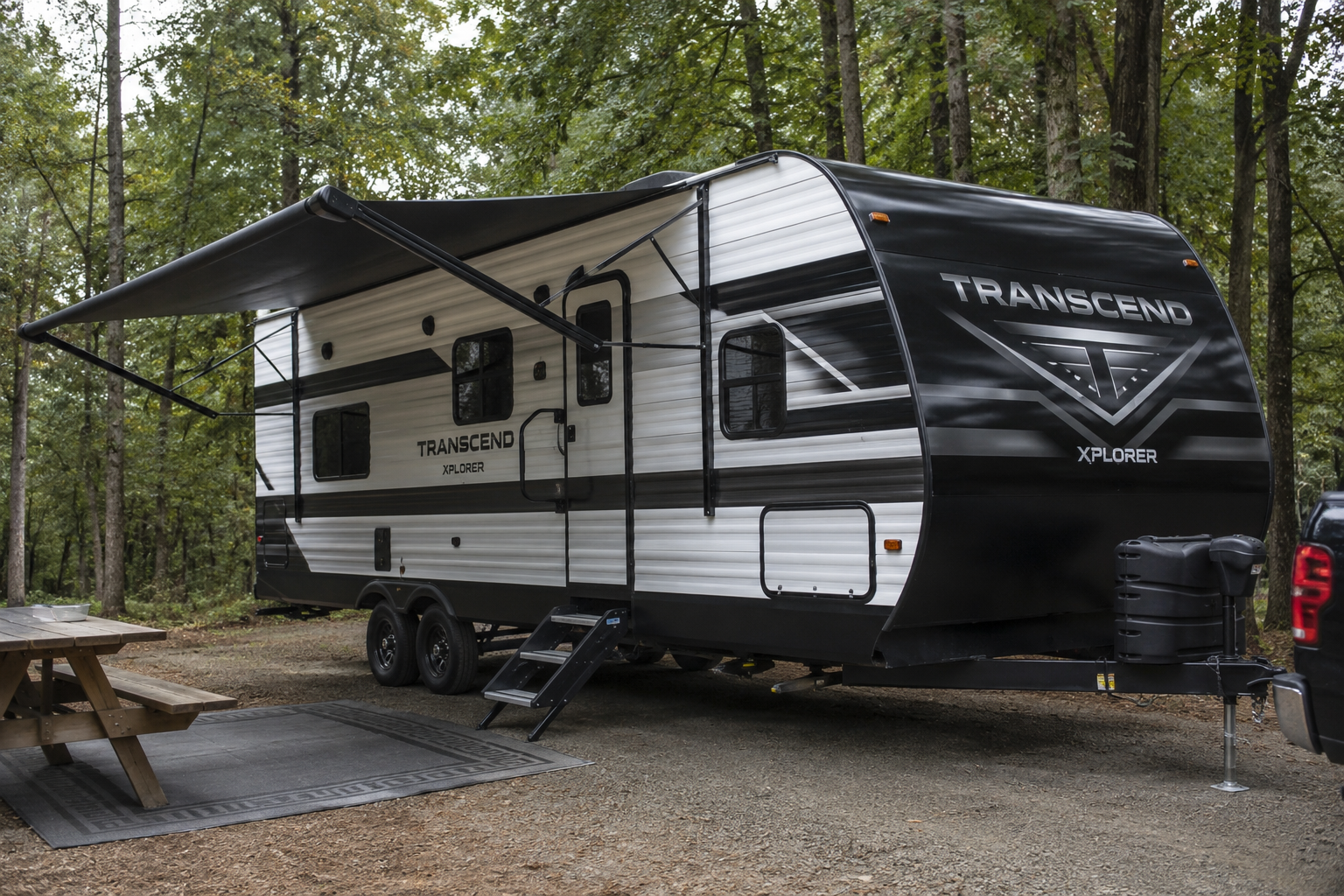
Our first travel-trailer camping trips taught us something a packing list never could: the small things are often what change your routine the most.
We went into those early trips trying to think of everything. We checked lists, packed the obvious RV equipment, brought our family supplies, and made sure Angel had what she needed.
Then we started discovering the things we had not thought about.
Water-hose gaskets were one example. A spare drinking-water hose was another. We also learned that having an extra water filter available can save an unexpected trip to a store when something is missing or needs to be replaced.
Those experiences changed how we camp.
We also developed a rule we still follow when arriving at a campsite: before we fully unhook our travel trailer and settle into the site, we check the campsite connections and make sure the electrical and water service we expect to use are working.
Our first-trip checklist is therefore much less about owning every RV accessory possible and much more about the lessons that helped us build a routine.
These are the things we wish we had understood when we started.
Affiliate Disclosure: This post may contain affiliate links. If you make a purchase, complete a booking or rental, create a qualifying listing, subscribe to a service, or take another qualifying action through one of these links, we may earn a commission at no additional cost to you.
As an Amazon Associate I earn from qualifying purchases.
Advertising Disclosure: This website may display advertisements provided by third-party advertising partners, including Google AdSense. Advertising helps support Travelers and a Schnauzer and allows us to continue providing free travel resources, destination guides, and planning tips for our readers.
Product Recommendation Notice: Products recommended throughout this article are selected because we believe they may be helpful for families traveling with their dogs. Recommendations are based on our experiences where applicable, general travel knowledge, product research, and suitability for the topic. Readers should evaluate products to determine what best meets their individual needs.
Our First RV Trips Were Really About Learning a System
Before we started camping regularly, it was easy to think successful RV camping came down to having the right equipment.
Equipment matters, of course.
What we learned fairly quickly was that routine matters just as much.
Knowing where equipment is stored, having backups for a few important items, following the same arrival process, and learning from every mistake have made a much bigger difference for us than simply adding more things to a list.
That is one reason our camping preparation looks different now.
We still use checklists, but the checklist has been shaped by what actually happened while we were traveling.
Lesson #1: A Tiny Water-Hose Gasket Can Become a Big Inconvenience
One of our early lessons came from the water hookup.
We had thought about the drinking-water hose itself. What we had not fully accounted for were the smaller pieces associated with connecting everything.
Water-hose gaskets are easy to overlook.
They are also exactly the type of little item we do not want to discover we need after arriving at the campground.
We have had to make a store run during a trip because we did not have what we needed for our water setup.
That experience permanently changed our checklist.
What We Do Differently Now
We keep spare water-hose gaskets with our RV water equipment instead of treating them as something we will remember individually.
They stay with the other hookup supplies.
That way, the question before a trip is no longer:
“Did we remember the little water-hose parts?”
Instead, we can check the water-equipment area as one complete system.
This is one of the biggest lessons our first trips taught us: if a small part is necessary for another piece of equipment to work properly, it belongs with that equipment.
Lesson #2: We Now Carry a Spare Drinking-Water Hose
A second lesson involved the hose itself.
After realizing how inconvenient a water-connection problem can become while camping, we decided carrying a spare drinking-water hose made sense for our family.
The spare gives us another option if our primary hose cannot be used or if we discover that our setup would work better with additional hose length.
We would rather give some storage space to a backup than spend part of a camping trip trying to locate a replacement.
For families building their own water-hookup setup, a Drinking Water Hose (paid link) is one option to consider:
We do not think every RV item needs a duplicate.
For us, the decision comes down to three questions:
- Would being without it significantly interfere with the trip?
- Is a replacement likely to be inconvenient to find?
- Is it practical to carry a spare?
A drinking-water hose meets those criteria for us.
Lesson #3: A Spare Water Filter Is Worth the Space for Us
Our early water-system lessons did not stop with the hose.
We also learned to carry an additional water filter.
Again, this came from the simple reality that replacing something during a camping trip takes time away from the trip itself.
If a filter is unavailable when we need one, we would rather reach into our RV supplies than find a store after arrival.
An Inline Water Filter (paid link) is one type of filter families may consider as part of an RV water setup:
The important part of our routine is not the specific brand of filter.
It is having the water equipment organized together and checking it before departure.
Lesson #4: We Check the Campsite Utilities Before Fully Unhooking
One of the biggest changes to our arrival routine has nothing to do with packing.
It happens after we back into the campsite.
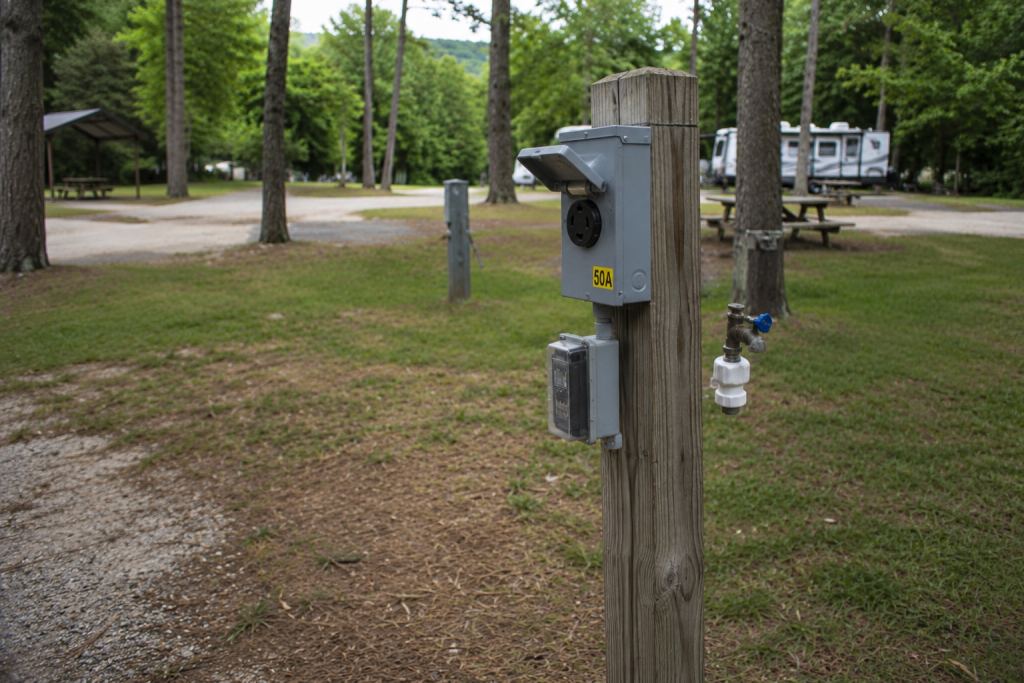
Before we completely unhook the travel trailer and move too far into campsite setup, we want to know that the campsite services we plan to use are available and functioning.
For us, that means checking the electrical connection and water connection.
This extra check gives us useful information before we fully commit to the site setup.
Why We Added This Step
Backing a travel trailer into a campsite takes time.
So does leveling, positioning, unhooking, stabilizing, extending slides, and getting the campsite organized.
We would rather identify a potential connection problem toward the beginning of that process than after everything has already been set up.
Our routine has therefore become:
Back in → evaluate the site → verify the connections we need → continue the setup.
That simple order gives us more confidence before we move farther into the process.
We Don’t Rush to Disconnect From the Tow Vehicle
Our earliest trips made us more deliberate about setup.
Once the trailer is backed into the site, the temptation is to start working through every task immediately.
We slow that process down.
Before unhooking, we pay attention to where the trailer is sitting and where the campsite utilities are located.
We also want to know that our planned position makes sense for the connections.
If something needs to change, it is much easier to address while we are still in the earlier stages of positioning the trailer.
Our Complete Travel Trailer Setup Checklist: Our Step-by-Step Routine for Stress-Free Camping walks through the setup process we use once we arrive:
That article focuses on setup order.
This one focuses on why our order changed after we started gaining experience.
Lesson #5: Water Equipment Works Better as a Kit
Our first few trips helped us stop viewing RV water equipment as individual pieces.
Now we think about it as one system.
That system can include:
- Drinking-water hose
- Spare drinking-water hose
- Water-hose gaskets
- Water pressure regulator
- Water filter
- Spare filter
- Other connection pieces our setup requires
Keeping related pieces together makes preparation much easier.
A Water Pressure Regulator (paid link) is another common component families may consider for an RV water hookup:
We follow our equipment manufacturer’s instructions and campground requirements when connecting our travel trailer.
The biggest organizational lesson for us is simply that everything associated with a particular system should have a logical home.
Our Store Run Changed More Than That One Trip
Having to go to a store for a forgotten or missing camping item is not a disaster.
But it is inconvenient.
The experience also gave us valuable information.
Instead of treating that store trip as a one-time annoyance, we asked:
What can we change so this is less likely to happen again?
That question became one of the ways we improve our camping setup.
If something important is forgotten, we add it to the appropriate list or assign it a permanent storage location.
If we wish we had a backup, we decide whether keeping a spare in the camper makes sense.
If something was difficult to reach, we reconsider where it belongs.
Our camping system has gradually become better because the mistakes are allowed to change the routine.
Not Everything From Our First Checklist Still Matters
Another thing we learned is that a long checklist is not automatically a better checklist.
Before a first trip, it is tempting to plan for every possible situation.
Once we had more experience, we could see which supplies actually mattered to the way our family camps.
Some items earned permanent places in the travel trailer.
Others became trip-specific.
A few became backups.
And some things turned out to be less important than we originally expected.
Our current master camping system is covered in Ultimate Camping Checklist for Families With Dogs:
That checklist now focuses on what permanently stays in our camper, what gets packed each trip, what receives a final check, and what repeated trips have taught us.
Lesson #6: Our First Trip Was Also About Learning Our Trailer
Reading about RV camping can help with preparation, but eventually we had to use our own travel trailer.
That was when everything started making more sense.
We became more familiar with:
- Where our setup equipment was stored
- Which equipment we reached for first
- How long different parts of setup took
- What needed to remain accessible
- What could stay permanently in the trailer
- What needed to be checked before every departure
- Which small backup items were worth carrying
That kind of knowledge only develops through use.
Our first trips did not simply teach us what to pack.
They taught us how our particular camping routine needed to work.
We Started Giving Equipment Permanent Storage Locations
After repeating the same setup several times, we realized that finding equipment should not be part of the challenge.
The water equipment needs to have a home.
Electrical equipment needs a home.
Sewer equipment needs a home.
Leveling and stabilization equipment needs a home.
Angel’s camping supplies need their own area too.
When something always goes back to the same place, preparing for another trip becomes much easier.
Our How We Keep Our Travel Trailer Organized During Trips article goes deeper into the organization system we use:
Lesson #7: Packing and Testing Are Two Different Jobs
Our first-trip mindset was heavily focused on bringing the right things.
Experience taught us that bringing equipment does not guarantee that the equipment or connection will work when we arrive.
That is why testing and checking became part of the routine.
Before leaving home, we want the trailer prepared.
After arriving, we want to verify the site and the connections before we move too far into setup.
Those are different checks.
Before Leaving Home
Our preparation is focused on our equipment and trailer.
After Reaching the Campsite
Our attention shifts to the individual site.
We look at where we are parked, where the connections are located, and whether the utilities we plan to use are working before continuing with the full setup process.
That distinction was not as obvious to us when we first started.
It is now part of how we camp.
Lesson #8: A First Trip Doesn’t Need a Complicated Meal Plan
One part of our original first-time checklist that still makes sense is keeping food simple.
A first RV trip already has plenty of new steps.
There is no reason for us to make dinner another complicated project.
We prefer camping meals that allow us to spend more time enjoying the trip and less time managing food preparation.
Our Camping Meals That Make Weekend Getaways Easier for Families article covers the meal approach that now works for us:
This is another area where experience helped.
Once we understood the camper kitchen and what we actually enjoyed making while camping, meal planning became much easier.
Lesson #9: Angel’s Gear Needs to Be Part of the Main Plan
Angel has always been part of our camping preparation.
One thing repeated trips have reinforced is that her supplies should not be treated as an afterthought.
Her food, water, leash, harness, medications when applicable, comfort items, cleanup supplies, and backups all need to be considered before we leave.
Keeping her supplies organized also makes arrival easier.
Instead of searching through family luggage for something Angel needs, we know which items belong with her camping gear.
Our 15 Things We Always Pack for Camping With Our Schnauzer focuses specifically on Angel’s regular camping supplies:
We have also learned a lot about what helps during the actual stay.
For more of those lessons, see Camping With a Miniature Schnauzer: Lessons We’ve Learned:
We Don’t Expect a First Trip to Be Perfect Anymore
Before our early camping trips, we spent a lot of time thinking about what we might forget.
Experience changed our perspective.
We still prepare carefully.
We just no longer think success means remembering every conceivable camping item on the first attempt.
The more useful goal is to have the important systems covered and be willing to improve afterward.
Our water-hose experience is a perfect example.
We discovered a gap.
We dealt with it.
Then we changed the routine.
That lesson became more valuable than simply checking another box on a generic list.
The Checklist We Would Use for a First Trip Now
If we were preparing for those early trips again, our checklist would be shorter and more focused.
Before Leaving Home
□ Confirm campground reservation information
□ Verify what hookups are included with the reserved site
□ Prepare the travel trailer
□ Check required RV equipment
□ Confirm water equipment is together
□ Pack spare water-hose gaskets
□ Pack the primary drinking-water hose
□ Pack the spare drinking-water hose
□ Check the water filter
□ Pack the spare filter
□ Confirm electrical equipment is loaded
□ Confirm sewer equipment if needed
□ Check leveling and stabilization equipment
□ Pack family food and clothing
□ Pack Angel’s supplies
□ Keep important safety equipment accessible
For our complete pre-trip trailer routine, see How We Prepare Our Travel Trailer for Every Weekend Trip:
What We Check After Backing Into the Campsite
This is the part of the first-time checklist we think deserves more attention.
Once we reach the site, we do not immediately treat parking as the end of the decision-making process.
We check the site before moving into the full setup.
Our basic thought process is:
□ Is the trailer positioned where we want it?
□ Are the utilities accessible from this position?
□ Is the electrical service we need available and working?
□ Is the water connection available and working?
□ Do our hoses and connections reach properly?
□ Is there anything about the site that requires repositioning?
□ Are we comfortable proceeding with unhooking and setup?
Only after those early checks do we continue through the rest of our normal setup routine.
Our Campground Selection Matters Too
Some first-trip problems can be reduced before arriving.
We now put much more thought into the site itself when making a reservation.
Site size, hookups, parking space, and the physical layout can all affect how smoothly arrival goes.
Our Campground Booking Checklist: What We Check Before Reserving a Site explains what we now evaluate before choosing a campsite:
That is another routine that became more detailed as we gained experience.
Families who are still comparing campgrounds may also want to check Campspot Campground Booking (paid link):
https://www.awin1.com/cread.php?awinmid=22326&awinaffid=2934315
What We Would Tell Another First-Time Travel-Trailer Family
We would not tell another family to buy every RV accessory they see before their first trip.
We would tell them to concentrate on the systems their particular trailer needs.
Know what is required for:
- Electrical connection
- Fresh-water connection
- Waste management
- Leveling and stabilization
- Towing and travel
- Family comfort
- Dog care, if traveling with a pet
Then organize those systems so the equipment works together.
The smaller pieces matter.
Our missing water-hose gaskets proved that.
Backups can matter too.
Our spare hose and filter are examples.
Most importantly, expect the first trip to teach you things no checklist could have predicted.
The Best Thing We Did Was Update the Checklist Afterward
A checklist should change when experience shows that something is missing.
That became one of our most useful habits.
After a trip, we can think about:
- What did we forget?
- What did we have to buy?
- What was difficult to find?
- What should stay in the camper permanently?
- What should have a backup?
- What step happened in the wrong order?
- What made setup easier?
Those questions have helped us turn a generic RV checklist into our family’s actual camping system.
Frequently Asked Questions
What did we forget on our early RV camping trips?
Some of the items we learned to carry were water-hose gaskets, a spare drinking-water hose, and an extra water filter. Not having what we needed resulted in an unexpected store trip and changed our future packing routine.
Why do we carry spare water-hose gaskets?
They are small, easy to store with our other water supplies, and not something we want to discover is missing after arriving at the campsite.
Why do we carry a spare drinking-water hose?
For our family, a backup is worth the storage space because losing access to our primary hose could interfere with our camping setup. It can also give us more flexibility with campsite connection locations.
Why do we keep a spare water filter?
Our early experiences taught us that replacing a water-system item during a camping trip is inconvenient. Keeping an additional filter with our RV supplies gives us another option when needed.
What do we check before unhooking our travel trailer?
We pay attention to trailer position, the location of the campsite utilities, and whether the water and electrical services we expect to use are working before moving too far into the unhooking and setup process.
Do first-time RV campers need every accessory immediately?
We do not think so. Our approach is to focus on the equipment required for our trailer and campsite setup, then adjust our supplies after seeing what actually works for our family.
How has our checklist changed over time?
It has become less about a huge universal packing list and more about systems. Items now have assigned storage areas, a few important supplies have backups, and our setup order reflects lessons from previous trips.
What is the biggest thing our first trips taught us?
Preparation matters, but experience matters too. Some of our most useful camping habits came from small mistakes that showed us exactly what needed to change.
Final Thoughts
Our first RV camping trips did not go badly because we forgot a few small things.
They helped us build a better system.
Not having the water-hose gaskets, spare hose, or replacement filter we wanted resulted in an inconvenient store run, but it also taught us what belonged permanently in our water hookup supplies.
That lesson stayed with us.
The same thing happened with our campsite setup routine.
Now we do not simply back in, unhook the travel trailer, and assume everything else will fall into place. We look at our position and check that the campsite water and electrical connections we plan to use are working before moving farther into setup.
Those habits are exactly what experience added to our checklist.
We still believe a written first-time RV camping checklist is useful.
We simply think the best version is one that keeps changing after you actually use it.
Every trip teaches us a little more about our camper, our family, Angel, and the way we prefer to camp.
That has been far more useful than trying to make our very first packing list perfect.
Related Articles
Complete Travel Trailer Setup Checklist: Our Step-by-Step Routine for Stress-Free Camping:
How We Prepare Our Travel Trailer for Every Weekend Trip:
Campground Booking Checklist: What We Check Before Reserving a Site:
Ultimate Camping Checklist for Families With Dogs:
15 Things We Always Pack for Camping With Our Schnauzer:
Camping With a Miniature Schnauzer: Lessons We’ve Learned:
How We Keep Our Schnauzer Safe at Campgrounds:
Before You Go
Travel Information Disclaimer: Travel information is provided for general planning purposes only. Regulations, policies, pet requirements, availability, admission fees, weather conditions, and operating hours may change. We recommend confirming current information directly with the applicable business, attraction, campground, airline, or government agency before traveling.
Accuracy Notice: We make every effort to provide accurate and up-to-date information. However, travel policies, operating hours, pet rules, reservation procedures, pricing, and other details may change without notice. Always verify important information directly with the official provider before making travel plans.
Safety Disclaimer: Every travel situation is unique. Always exercise good judgment, follow posted rules, comply with local laws, monitor weather conditions, and prioritize the safety of yourself, your family, and your pets. Travelers and a Schnauzer is not responsible for decisions made based on the information contained in this article.
Outdoor Recreation Disclaimer: Outdoor recreation involves inherent risks that may include changing weather, wildlife encounters, uneven terrain, and other natural hazards. Always prepare appropriately, carry necessary safety equipment, follow park regulations, and evaluate conditions before participating in outdoor activities.
RV & Camping Disclaimer: Safe RV operation and campground use require proper planning, equipment maintenance, and adherence to manufacturer recommendations and campground regulations. Always follow applicable safety procedures and consult qualified professionals whenever necessary.
Pet Travel Disclaimer: Every pet has different needs, abilities, and comfort levels while traveling. Evaluate your dog’s health, temperament, and travel readiness before each trip, and verify current pet policies with transportation providers, accommodations, attractions, and campgrounds before departure.
Product Information Disclaimer: Product features, specifications, availability, warranties, and manufacturer recommendations may change over time. Always review the manufacturer’s official information before purchasing or using any product discussed on this website.
Leave a Reply