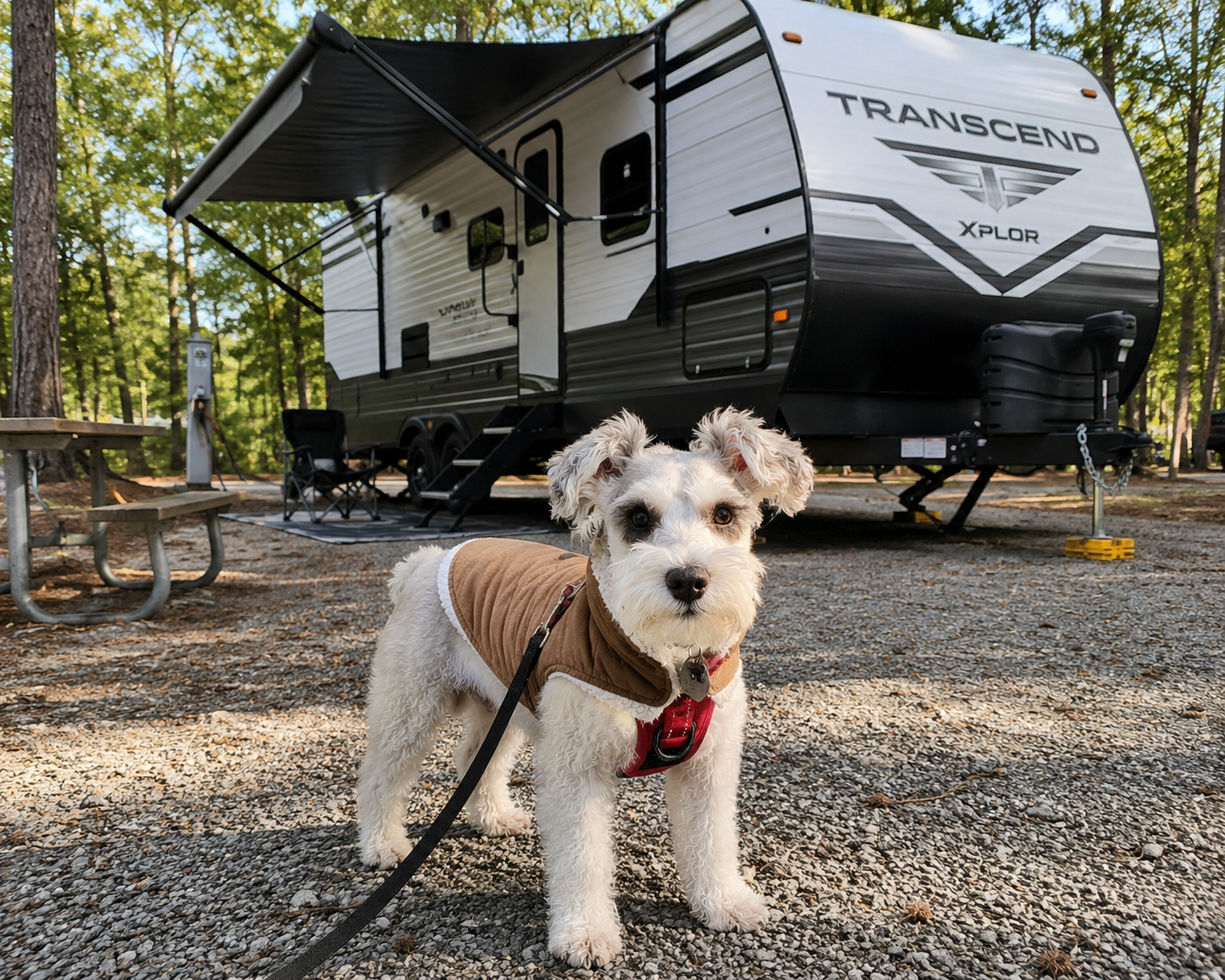
Our camping checklist looks very different now than it did when we first started taking trips in our travel trailer.
At first, we treated almost everything like traditional vacation packing. Before every trip, we thought about bedding, campground gear, dog supplies, kitchen items, safety equipment, clothing, food, and everything else we might need.
After enough camping trips, we realized that was making preparation harder than it needed to be.
Now we use a system.
Some things permanently belong to the camper. Other supplies need to be packed fresh before every trip. Angel has her own camping setup, and a few things receive a separate final check because we have actually forgotten them before.
One forgotten spare leash led to an unplanned stop at a store. Leaving our jump starter with air compressor behind on another trip changed how we handle vehicle emergency gear. We also learned that anything we repeatedly wash, restock, or recharge needs to go back to its designated place soon after we return home.
Our camping checklist is no longer just a list of hundreds of items.
It is the routine we use to make sure the camper is already partly ready before we ever start packing for the next trip.
Disclosures
Affiliate Disclosure: This post may contain affiliate links. If you make a purchase, complete a booking or rental, create a qualifying listing, subscribe to a service, or take another qualifying action through one of these links, we may earn a commission at no additional cost to you.
As an Amazon Associate I earn from qualifying purchases.
Advertising Disclosure: This website may display advertisements provided by third-party advertising partners, including Google AdSense. Advertising helps support Travelers and a Schnauzer and allows us to continue providing free travel resources, destination guides, and planning tips for our readers.
Product Recommendation Notice: Products recommended throughout this article are selected because we believe they may be helpful for families traveling with their dogs. Recommendations are based on our experiences where applicable, general travel knowledge, product research, and suitability for the topic. Readers should evaluate products to determine what best meets their individual needs.
The Biggest Change: We Stopped Packing the Camper From Scratch
Repeated camping trips taught us that the easiest item to pack is the one that never has to leave the camper.
That sounds simple, but it changed the entire way we prepare.
Instead of creating one giant list and packing everything again before each trip, we divide our camping supplies into three groups:
- Things that permanently belong to the travel trailer
- Things we intentionally add before every trip
- Things that receive a final departure check
That distinction saves us from asking the same questions every time.
We do not need to wonder whether the camper has basic setup equipment if that equipment already has a permanent home.
We can concentrate instead on food, clothing, Angel’s trip-specific supplies, medications, electronics, and the few things that cannot remain in the camper between trips.
What Permanently Stays With Our Travel Trailer
The first part of our system is deciding which items should essentially belong to the camper.
These are things that are used repeatedly while camping and do not make sense for us to carry back and forth before every weekend trip.
Our Bedding Stays in the Camper
Sleeping supplies are one of the easiest examples.
We keep our travel-trailer bedding with the camper instead of packing it from the house each time.
After a trip, we wash what needs washing and return it to the trailer.
That final step matters.
If clean bedding remains in a laundry basket inside the house for several days, it can easily become something we need to remember again before the next trip.
Returning it immediately resets that part of the camper.
When the next camping weekend comes around, bedding is already handled.
Core RV Equipment Has Its Own Permanent Home
Travel-trailer setup equipment is another category we do not want mixed into general family luggage.
Our camper needs specific equipment to be useful once we reach the campsite.
That includes the types of items associated with leveling, stabilizing, water connections, electrical connections, and sewer hookups.
Examples from our normal camping setup include:
- Leveling blocks
- Wheel chocks
- X-chocks
- Water pressure regulator
- Drinking-water hose
- Water filter
- Sewer hose and related equipment
- Electrical adapters
- Outdoor electrical equipment
- Campsite organization supplies
The important part of our system is not simply owning those things.
It is giving them a dedicated camper location.
If something is always stored in the same place, campsite setup becomes more predictable.
Our Complete Travel Trailer Setup Checklist: Our Step-by-Step Routine for Stress-Free Camping covers what we do with that equipment after we arrive:
That article handles setup.
This one handles making sure the system that supports setup is ready before we leave home.
Organization Became More Important as We Added Gear
Camping gear tends to accumulate.
At first, adding one more useful item does not seem like a big deal.
After enough trips, though, a camper can become full of things that technically have a purpose but are difficult to find when needed.
We have found that storage works much better when categories have designated places.
A basket for one type of supply is much easier to manage than moving items from cabinet to cabinet.
For families building a similar system, Storage Baskets (paid link) are one organizational option:
The container is not the important part.
The important part is knowing where something belongs.
Our How We Keep Our Travel Trailer Organized During Trips article goes deeper into how we handle camper organization:
What We Still Pack Before Every Camping Trip
Keeping supplies in the camper does not eliminate packing.
It simply narrows the job.
Before each trip, we focus on the things that cannot realistically stay in the trailer between vacations.
Those include the supplies that change based on the destination, weather, trip length, meals, and what our family needs that particular weekend.
Clothing Is Always Trip-Specific
Clothing never belongs on our permanent-camper list.
The amount and type depend too much on the trip.
A summer camping weekend requires something very different from a cool mountain trip.
Instead of storing a complete camping wardrobe in the trailer, we check the forecast and pack for what we actually expect to do.
That generally means thinking about:
- Daytime clothing
- Sleepwear
- Shoes
- Extra socks
- Layers
- Rain gear when appropriate
- Jackets or sweatshirts when needed
- An extra change of clothes
Our camper may already contain many of the things required to camp, but our personal bags still need to match the actual trip.
Food Starts With a Meal Plan
Food is another every-trip category.
We prefer planning meals before we leave instead of filling the camper with ingredients and deciding what to make once we arrive.
Knowing the meals ahead of time makes the grocery list easier.
It also helps us avoid carrying food that never gets used.
Our basic process is:
- Decide what we plan to eat.
- Check what is already available.
- Buy the ingredients we need.
- Organize food for the camper.
- Load refrigerated or frozen items at the appropriate time.
An Airtight Container (paid link) can be useful for organizing dry ingredients or food during camping trips:
We use the same overall planning philosophy in Camping Meals That Make Weekend Getaways Easier for Families:
The goal is not creating an elaborate menu.
We want camping meals to be easy enough that food preparation does not take over the trip.
We Restock Instead of Repacking Some Consumables
There is an important difference between something that lives in the camper and something that stays there only while the supply lasts.
Paper products, cleaning supplies, trash bags, and other consumables fall into that category.
Those items may stay in the camper between trips, but they still need to be checked.
If we used the last of something on Sunday and never replaced it, technically the product has a permanent storage location—but it will not be there when we need it next time.
That taught us to think in terms of restocking, not merely storing.
Our return-home routine is therefore part of our next departure routine.
Angel Has Her Own Camping System
Packing for Angel used to be easy to mix into everything else.
Her food might be with kitchen supplies. A leash could be near the door. Towels might be with family towels. Toys could end up almost anywhere.
Giving her supplies their own places made camping preparation much simpler.
We use a dedicated drawer and storage area for Angel’s camping gear so we know where to look.
Some items can remain assigned to the camper.
Others have to be added each trip.
What Angel Needs Every Camping Trip
Angel’s camping supplies generally fall into a few practical groups.
Food and Water
Her food needs to be packed for the actual length of the trip.
Water also needs to remain accessible during travel and at the campsite.
A Dog Travel Water Bottle (paid link) can be useful for road-trip stops and campground walks:
Walking Gear
We bring Angel’s normal walking gear plus backups.
That was not always part of our system.
We once forgot her spare leash and ended up stopping at a store to buy another one.
The experience was inconvenient enough that we changed the checklist afterward.
Now we make sure we have:
- Regular leash
- Spare leash
- Regular harness
- Spare harness
- Waste bags
- Identification
The lesson was bigger than the leash itself.
For small items that are important and easy to duplicate, carrying a backup can be simpler than trying to replace one while traveling.
Our 15 Things We Always Pack for Camping With Our Schnauzer focuses specifically on Angel’s regular camping gear:
Familiar Items Help Angel’s Campsite Feel Normal
Camping means new smells, new sounds, new people, and a completely different outdoor environment.
We still like Angel to have some familiar things with her.
Her bed or blanket, favorite toys, and normal supplies give her recognizable things within a new campsite.
This is not about filling the camper with dog belongings.
A few familiar items are enough for our routine.
Our Camping With a Miniature Schnauzer: Lessons We’ve Learned article shares more of what repeated trips have taught us about camping with Angel:
Cleanup Supplies Earned a Permanent Place Too
Camping with a dog means dirt eventually comes inside.
Wet grass, dusty campground roads, mud, and everyday outdoor exploring can all end up on paws.
We would rather deal with that at the camper entrance than after Angel has walked through the entire trailer.
For that reason, dog cleanup supplies are something we like to have readily available.
Depending on the trip, that may include:
- Paw towel
- Wipes
- Brush
- Waste bags
- Basic cleanup supplies
Again, the system matters more than the size of the collection.
If we know where the towel is when Angel comes back with wet paws, the system is working.
Angel’s Emergency Supplies Stay Easy to Reach
We also travel with basic emergency and first-aid supplies for Angel.
Those are not useful if they are buried underneath everything else.
Our Pet Travel Emergency Kit Checklist: What We Keep Ready for Angel explains the supplies we keep available and why several have been useful during actual trips:
A Pet First Aid Kit (paid link) is one option for families creating their own travel setup:
We recommend opening any premade kit before a trip so you know what is actually inside and whether it fits your dog’s needs.
What We Have Forgotten Changed the Checklist
The most useful parts of our camping system did not always come from planning ahead.
Some came from forgetting something.
Those are the lessons that tend to stay on a checklist permanently.
We Once Forgot Our Jump Starter With Air Compressor
Our jump starter with air compressor is one of the pieces of vehicle emergency equipment we want with us during trips.
At one point, we left it behind.
Nothing went wrong because it was missing, but the experience still exposed a flaw in our system.
We owned the equipment.
We simply had not made confirming that it was loaded part of departure.
Now it stays easy to access during travel, and we specifically check for it rather than assuming it is somewhere in the vehicle.
Families who want a similar type of emergency tool can review a Jump Starter Air Compressor (paid link):
The lesson for us was straightforward:
“We own one” is not the same as “it is in the vehicle.”
Forgetting Angel’s Spare Leash Created Another Rule
The spare leash mistake taught us something slightly different.
We had Angel’s regular walking equipment.
What we had forgotten was the backup.
Because we wanted another leash available, we ended up making a store stop during the trip.
That small inconvenience changed our packing routine.
Angel’s spare leash is now something we deliberately check.
We also began carrying a spare harness because it falls into the same category: small, important, and relatively easy for us to keep as a backup.
Repeated trips have slowly turned experiences like these into permanent checklist items.
Our Checklist Changes After Trips
We do not treat our camping checklist as finished.
If something causes an unnecessary problem during a trip, we ask whether our system should change.
Sometimes the answer is to add an item.
Other times the better solution is to change where something is stored.
We might realize that:
- An item should permanently stay in the camper.
- Something should move closer to the camper door.
- A backup belongs with Angel’s supplies.
- A consumable needs a minimum restock level.
- Emergency equipment belongs in the tow vehicle.
- Something we never use can be removed entirely.
That last point matters too.
A better camping system is not always about adding more gear.
Sometimes improvement means carrying less.
We Reset the Camper After We Get Home
One of the biggest improvements we have made is recognizing that the next trip starts when the current one ends.
If we unload everything and walk away from the camper, the next trip begins with a lot more work.
Instead, we try to reset what we can.
Bedding Gets Washed and Returned
Our sleeping supplies go back into the travel trailer after they are cleaned.
That means they are ready the next time.
Used Supplies Get Restocked
If we used the last trash bag, cleaning item, or other consumable, we want to replace it before forgetting.
Gear Goes Back to Its Assigned Location
Setup equipment should return to the same place it came from.
That is what makes the storage system useful.
Rechargeable Items Need Attention
Anything that depends on a charged battery needs more than a storage location.
A dead power bank stored perfectly is still not ready for the next trip.
Angel’s Supplies Get Reset Too
We make sure her camping area has what should remain there and identify anything that has to be packed fresh next time.
This return-home reset reduces the number of jobs waiting for us before our next weekend away.
How We Prepare the Camper Before the Next Trip
When the next trip arrives, we do not start by asking, “What does a camper need?”
Most of that has already been decided.
Instead, we focus on what has changed.
That includes:
- Destination
- Trip length
- Weather
- Meals
- Clothing
- Angel’s food and trip-specific needs
- Medications
- Electronics
- Fresh supplies
- Anything used since the previous trip
Our How We Prepare Our Travel Trailer for Every Weekend Trip article walks through that pre-trip process in more detail:
Separating that process from this master system keeps the articles from doing the same job.
Our Camping System at a Glance
Here is how we now divide the work.
Stays With the Camper
- Bedding and sleeping supplies
- Core RV setup equipment
- Water hookup equipment
- Sewer hookup equipment
- Electrical connection equipment
- Camper organization supplies
- Basic campsite equipment that has a permanent storage location
- Selected cleanup supplies
- Reusable camper-specific kitchen items
- Supplies that make more sense belonging to the trailer than the house
Gets Packed for Every Trip
- Clothing
- Personal toiletries
- Family medications
- Trip-specific food
- Refrigerated and frozen items
- Drinks
- Phones and personal electronics
- Destination-specific items
- Weather-specific clothing or gear
- Angel’s food
- Angel’s current medications when applicable
- Angel’s everyday leash and harness
- Angel’s familiar comfort items
- Anything needed specifically for that camping weekend
Gets a Final Confirmation
- Jump starter with air compressor
- Family emergency supplies
- Angel’s spare leash
- Angel’s spare harness
- Necessary medications
- Phones and chargers
- Reservation information
- Food that had to stay refrigerated until departure
- Items used on the morning we leave
- Anything that would be difficult to replace once we are on the road
That three-part system has become more useful to us than simply maintaining one enormous master packing list.
Where a First-Time Camping Checklist Still Helps
A traditional checklist is still very useful when you are starting.
Before you know what permanently belongs in your camper, you have to think through almost everything.
Our First-Time RV Camping Checklist: What Our First Trips Taught Us is designed more for that stage:
After repeated trips, though, our goal became different.
We were no longer asking:
What does a family need to camp?
We were asking:
How can we make sure our camper is already mostly ready before the next trip begins?
That is what this system solves.
We Also Separate Packing From Campsite Setup
Another change that has helped us is keeping the stages separate.
Packing should answer:
Is everything coming with us?
Travel-trailer preparation should answer:
Is the camper ready to travel?
Campsite setup should answer:
How do we safely get everything connected and ready once we arrive?
Those are different jobs.
Trying to make one checklist handle all three creates an unnecessarily complicated document.
Keeping them separate allows us to concentrate on the job we are actually doing.
Angel’s Camping Checklist Has Changed With Ours
Angel is not an extra line at the bottom of the family checklist.
Her supplies are one of the core parts of our camping routine.
Repeated trips have made that more obvious.
We think about:
- What she uses every day
- What needs a backup
- What she needs during the drive
- What stays accessible at the campsite
- What keeps her comfortable
- What helps us clean her paws before she comes inside
- What we would need if something unexpected happened
Our How We Keep Our Schnauzer Safe at Campgrounds article focuses more specifically on campsite considerations:
This article remains focused on making sure her supplies are part of the overall camping system before we arrive.
What We Would Tell Families Building Their Own System
We would not recommend copying another family’s list item for item.
Start with the way your family camps.
A useful system should reflect:
- Your camper
- Your storage space
- Your family
- Your dog
- Your usual trip length
- Your camping style
- The equipment you actually use
- The mistakes you have already learned from
The biggest improvement comes when an item no longer has to be remembered because it has an assigned place and an established routine.
That is the point we try to reach with our own camper.
Frequently Asked Questions
What do we permanently keep in our travel trailer?
We keep supplies in the camper that are repeatedly used for camping and do not need to return to the house after each trip. Bedding and core trailer equipment are good examples. Our goal is to reduce how much has to be packed from scratch.
What still has to be packed before every camping trip?
Food, clothing, personal items, medications, electronics, weather-specific gear, and many of Angel’s everyday supplies still need to be packed based on the individual trip.
Why do we keep bedding in the camper?
It removes an entire packing category from our pre-trip routine. After a camping trip, we wash what needs washing and return it to the travel trailer so it is ready again.
What camping items have we forgotten before?
We have previously left our jump starter with air compressor behind. We also forgot Angel’s spare leash and had to stop at a store to purchase another one. Both experiences resulted in changes to our normal trip checks.
Why do we carry backup dog gear?
After forgetting Angel’s spare leash, we decided it made sense for our travel style to carry a backup leash and harness. They are small enough to store easily and important enough that we prefer having another option available.
How do we keep from overpacking the camper?
We regularly consider whether an item actually gets used. Permanent storage should be reserved for supplies that earn their space rather than becoming a place to collect more camping gear.
When do we update our camping checklist?
After trips. If we forgot something, could not find something, ran out of something, or carried gear we never used, that is useful information for the next trip.
What is the easiest way to make camping preparation faster?
For us, the biggest improvement was separating permanent camper supplies from every-trip packing. Resetting the camper after each trip also means fewer jobs are waiting before the next one.
Final Thoughts
Our camping checklist became much more useful when we stopped treating it as one giant list of things we might need.
Repeated travel-trailer trips helped us build a system instead.
Bedding gets washed and returned to the camper.
Core RV equipment has its own storage space.
Consumables get restocked.
Food, clothing, and other trip-specific supplies get added based on where we are going.
Angel has her own dedicated supplies, including the backup leash and harness that became part of our routine after we once forgot her spare leash.
Vehicle emergency equipment also receives its own check after we learned that having a jump starter at home did us no good if we forgot to put it in the vehicle.
None of these changes happened all at once.
Our camping routine became easier a little at a time as we noticed what worked, what did not, what we repeatedly forgot, and what we were tired of packing over and over again.
That is why our best camping checklist is not really a checklist anymore.
It is a cycle:
Use the camper → notice what worked → fix what did not → reset everything → pack only what changes → go camping again.
For our family, that system saves more time than adding another hundred items to a master packing list.
Related Articles
15 Things We Always Pack for Camping With Our Schnauzer:
First-Time RV Camping Checklist: What Our First Trips Taught Us:
How We Prepare Our Travel Trailer for Every Weekend Trip:
Complete Travel Trailer Setup Checklist: Our Step-by-Step Routine for Stress-Free Camping:
How We Keep Our Travel Trailer Organized During Trips:
Camping With a Miniature Schnauzer: Lessons We’ve Learned:
Pet Travel Emergency Kit Checklist: What We Keep Ready for Angel:
Before You Go
Travel Information Disclaimer: Travel information is provided for general planning purposes only. Regulations, policies, pet requirements, availability, admission fees, weather conditions, and operating hours may change. We recommend confirming current information directly with the applicable business, attraction, campground, airline, or government agency before traveling.
Accuracy Notice: We make every effort to provide accurate and up-to-date information. However, travel policies, operating hours, pet rules, reservation procedures, pricing, and other details may change without notice. Always verify important information directly with the official provider before making travel plans.
External Links Disclaimer: This article may contain links to third-party websites for your convenience. Travelers and a Schnauzer is not responsible for the content, availability, accuracy, or privacy practices of external websites. Readers should review the policies and terms of any website they choose to visit.
Safety Disclaimer: Every travel situation is unique. Always exercise good judgment, follow posted rules, comply with local laws, monitor weather conditions, and prioritize the safety of yourself, your family, and your pets. Travelers and a Schnauzer is not responsible for decisions made based on the information contained in this article.
Outdoor Recreation Disclaimer: Outdoor recreation involves inherent risks that may include changing weather, wildlife encounters, uneven terrain, and other natural hazards. Always prepare appropriately, carry necessary safety equipment, follow park regulations, and evaluate conditions before participating in outdoor activities.
Emergency Preparedness Disclaimer: Emergency preparedness recommendations are intended to improve readiness but cannot anticipate every situation. Evaluate your family’s individual needs, local conditions, and applicable emergency guidance when preparing for travel or emergencies.
RV & Camping Disclaimer: Safe RV operation and campground use require proper planning, equipment maintenance, and adherence to manufacturer recommendations and campground regulations. Always follow applicable safety procedures and consult qualified professionals whenever necessary.
Pet Travel Disclaimer: Every pet has different needs, abilities, and comfort levels while traveling. Evaluate your dog’s health, temperament, and travel readiness before each trip, and verify current pet policies with transportation providers, accommodations, attractions, and campgrounds before departure.
Veterinary Disclaimer: The information provided in this article is intended for general educational and informational purposes only and should not be considered veterinary advice. Every dog has unique health needs. Always consult your licensed veterinarian regarding questions about your pet’s health, medications, allergies, nutrition, or medical care before making changes to your pet’s routine or treatment plan.
Product Information Disclaimer: Product features, specifications, availability, warranties, and manufacturer recommendations may change over time. Always review the manufacturer’s official information before purchasing or using any product discussed on this website.
Leave a Reply