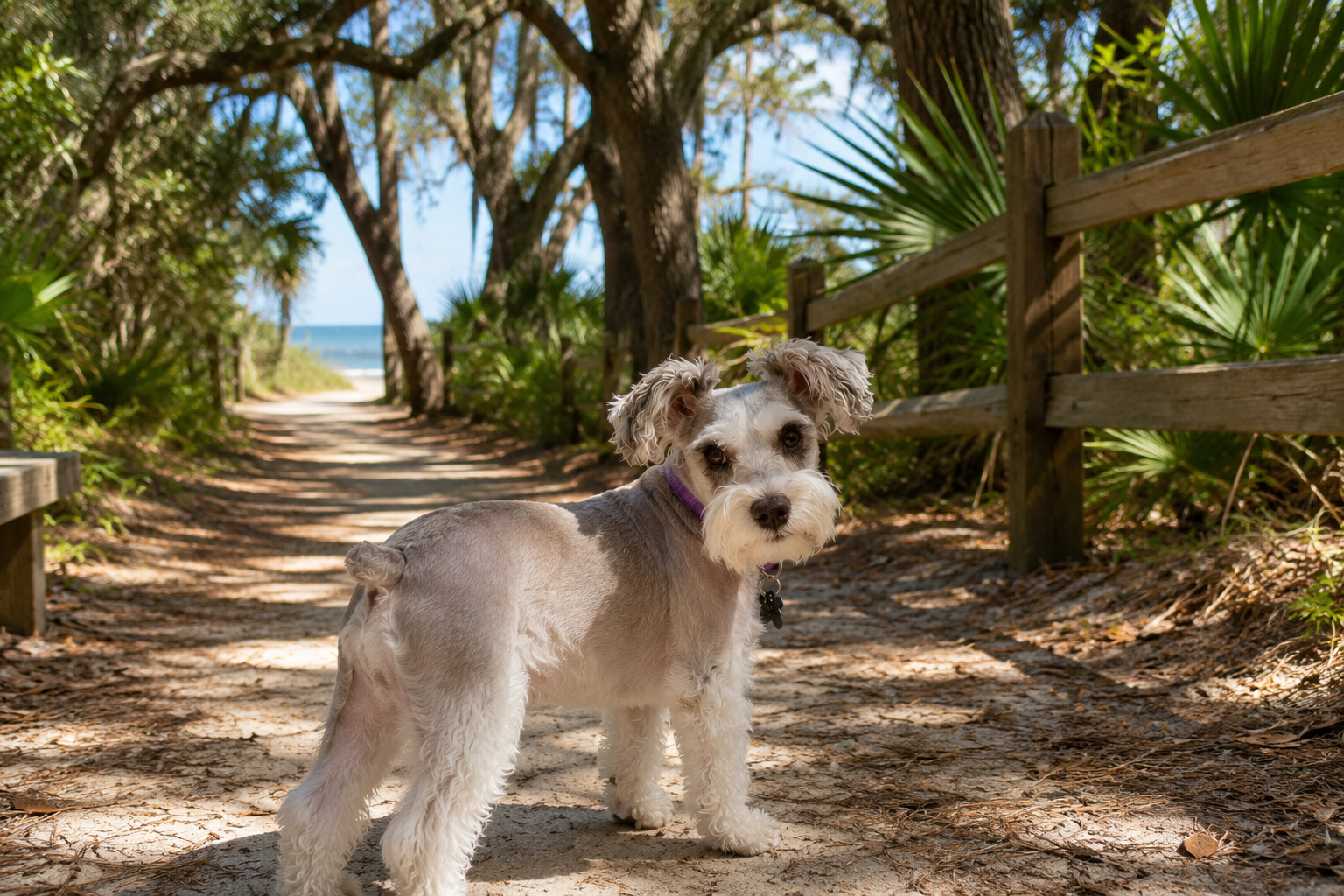
We’ve spent time in the Myrtle Beach State Park area ourselves, and for our family, it offers a very different experience from the busier parts of Myrtle Beach. When we travel with our Miniature Schnauzer, Angel, we tend to enjoy destinations where we can mix outdoor time with quieter breaks instead of moving from one crowded attraction to another.
That is one reason the State Park area works well for the way we travel. We can spend time near the beach, walk through wooded areas, take shorter nature walks, stop for a picnic, and adjust our plans when Angel needs a break.
Traveling here with a dog also changes how we plan the day. Beach hours, heat, shade, pavement and sand temperatures, water, leash rules, parking, and how busy an area becomes all matter much more when Angel is with us.
In this guide, we’re sharing what we’ve learned from spending time in the Myrtle Beach State Park area along with current planning information for pet rules, camping, nearby outdoor areas, and things we would consider when planning another visit.
Current park information in this guide was checked in August 2026. Because pet policies, operating procedures, parking conditions, and other rules can change, we still recommend verifying the latest information before your trip.
Affiliate Disclosure: This post may contain affiliate links. If you make a purchase, complete a booking or rental, create a qualifying listing, subscribe to a service, or take another qualifying action through one of these links, we may earn a commission at no additional cost to you.
As an Amazon Associate I earn from qualifying purchases.
Advertising Disclosure: This website may display advertisements provided by third-party advertising partners, including Google AdSense. Advertising helps support Travelers and a Schnauzer and allows us to continue providing free travel resources, destination guides, and planning tips for our readers.
Why We Like the Myrtle Beach State Park Area With Angel
One of the biggest advantages of the State Park area for us is flexibility.
We do not have to decide between spending the entire day on the beach or leaving the area altogether. The park combines ocean access with a maritime forest, picnic areas, nature trails, camping, and other places where we can slow the day down.
That matters when Angel is with us.
A beach outing that sounds simple can become uncomfortable quickly if the sand is hot, the sun is intense, or there is nowhere convenient to take a break. Having wooded areas and shorter walks nearby gives us more options.
We also prefer being able to change our plans based on how Angel is doing rather than feeling committed to a long itinerary.
For our family, that usually leads to a better travel day.
Start With Myrtle Beach State Park
If the purpose of the trip is to enjoy the Myrtle Beach State Park area with a dog, we would make the park the center of the day rather than treating it only as a way to reach the beach.
The park has a mixture of coastline and maritime forest, which creates several ways to spend time outdoors without having to continually drive between stops.
Two of the park’s shorter trails are especially manageable when we are looking for a lighter outing.
The Sculptured Oak Trail is approximately 0.5 miles, and the Yaupon Trail is approximately 0.4 miles. Both are listed as easy trails and connect through the wooded portion of the park toward the beach.
Short walks like these fit the way we often travel with Angel. We can let her explore without automatically committing her to a long hike, and we can turn the outing into part of the day rather than the entire activity.
That is particularly helpful during warmer months.
Know the Myrtle Beach State Park Dog Rules Before You Arrive
This is one part of the trip we would verify every time we visit.
Myrtle Beach State Park currently allows pets in most outdoor areas throughout the year as long as they are physically restrained or kept on a leash no longer than six feet.
There is an important seasonal beach restriction.
From May 1 through Labor Day, dogs are not permitted on the beach between 10 a.m. and 5 p.m.
For us, that changes how we would build the entire day.
Instead of arriving in the middle of the afternoon expecting several hours of beach time with Angel, we would plan around the permitted hours.
During the seasonal restriction period, an itinerary might look more like:
- Early morning beach time with Angel
- A shaded or wooded break after leaving the beach
- A short nature walk if temperatures and surfaces are comfortable
- Lunch and downtime during the hottest part of the day
- Another outdoor outing later in the afternoon
- Beach time again after dogs are permitted
We would still check the current rule shortly before leaving home. Coastal ordinances and park policies can change, and we do not want to build an entire day around information we remembered from a previous trip.
Official Myrtle Beach State Park information:
https://southcarolinaparks.com/myrtle-beach
Arriving Earlier Can Make the Day Easier
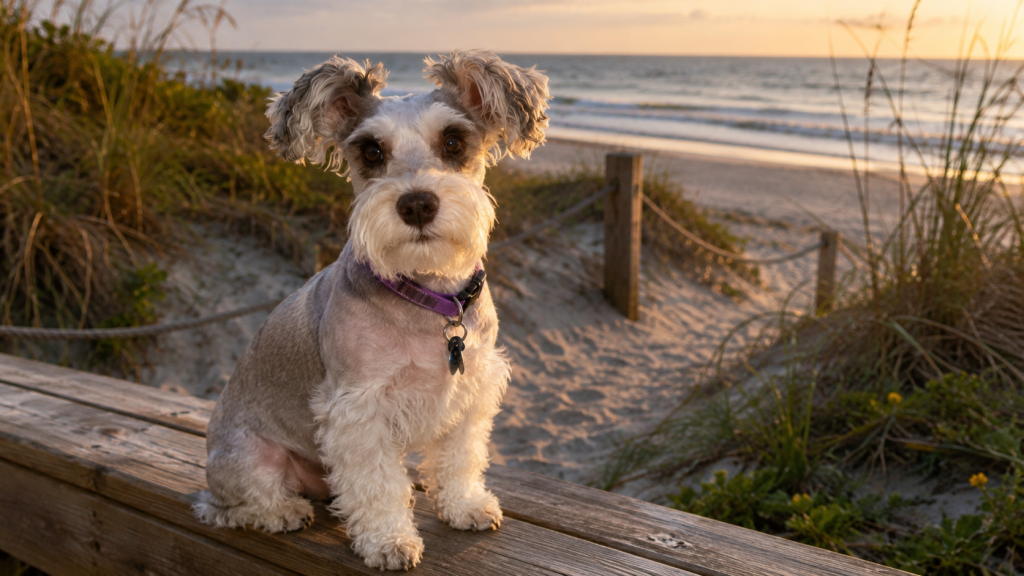
One improvement we would make to almost any warm-weather visit is arriving earlier.
It is not only about temperature.
Myrtle Beach State Park currently warns visitors that parking is limited and that the park can become extremely busy during peak periods, particularly on summer weekends and holidays.
The park specifically identifies approximately 10 a.m. to 2 p.m. as a peak period when parking and capacity can become more challenging.
With Angel, arriving before the busiest part of the day gives us several advantages.
We can usually enjoy cooler conditions, avoid putting her onto hot surfaces unnecessarily, and have more flexibility if the first activity we planned does not work.
It also reduces the pressure to continue an outing simply because getting parked took a long time.
When we travel with Angel, flexibility usually matters more than squeezing the maximum number of attractions into one day.
Pay Attention to More Than the Air Temperature
Warm coastal weather changes how we travel with Angel.
The number showing on a weather app is only one part of the picture.
We also pay attention to:
- Direct sun
- Shade availability
- Sand temperature
- Pavement temperature
- How long Angel has been outside
- Whether she has been drinking normally
- How much walking she has already done
- Whether an area feels crowded or stressful
A place can technically allow dogs and still not be comfortable for every dog at every time of day.
We would rather shorten an outing than keep going simply because something was on our itinerary.
That lesson applies especially well to beach destinations.
For more about what we change when taking Angel to the coast, see:
Dog-Friendly Beach Trips: What We Pack Differently for Angel
Use the Wooded Areas as Part of the Day
The maritime forest is one of the features that makes Myrtle Beach State Park more useful to us than an outing centered entirely around an exposed beach.
We would not treat the wooded trails as guaranteed relief from summer heat, because temperatures and humidity can still be high.
What they do provide is another type of environment.
Instead of spending several continuous hours on sand, we can change surfaces, look for shaded areas, take a shorter walk, or simply slow down.
When Angel is traveling with us, those transitions can make an outing easier.
We also keep her leashed and stay alert around wildlife. State parks are natural environments, and wildlife should be given plenty of space.
Consider Huntington Beach State Park for Another Outdoor Day
If you are staying in the area for more than one day, Huntington Beach State Park gives you another coastal option south of Myrtle Beach.
The park has beach access, wetlands, wildlife-viewing areas, camping, and Atalaya.
The pet rules are different from Myrtle Beach State Park, so this is another place where we would check the details rather than assume one state park follows the same rules as another.
Huntington Beach State Park currently allows dogs year-round as long as they remain on a leash no longer than six feet.
Dogs are permitted on the south end of the beach.
They are prohibited on the north end of the beach and inside park buildings, including Atalaya.
If we were planning a visit with Angel, we would decide ahead of time whether the activities we wanted to do actually allowed her rather than discovering the restriction after arriving.
That is especially important if Atalaya is a major reason for your visit.
Official Huntington Beach State Park information:
https://southcarolinaparks.com/huntington-beach
Add Murrells Inlet When You Want a Slower Evening
Murrells Inlet can work well as a transition after spending part of the day outdoors.
The waterfront MarshWalk area gives families a place to slow the pace, walk near the water, and consider stopping for dinner.
When Angel is with us, we do not assume that an outdoor restaurant patio automatically means dogs are allowed.
We check directly with the individual restaurant.
Pet policies can vary from one business to another and may change, so confirming before arriving saves us from reorganizing dinner plans after we are already there.
We also think about timing.
A waterfront restaurant area may feel completely different earlier in the day than it does during a busy evening period. If an area becomes crowded or noisy, that influences whether we think Angel will enjoy being there.
Our general approach to restaurant planning with Angel is explained in:
Dog-Friendly Restaurants We Look for While Traveling With Our Schnauzer
We Build Downtime Into Coastal Trips
We do not try to fill every hour of a trip.
That is particularly true when Angel has already spent time at a beach, on trails, or in unfamiliar surroundings.
Some of the best parts of a travel day happen when we stop adding activities.
We might return to our campsite or accommodations for a while, sit somewhere shaded, take a slower walk, or simply let Angel rest.
Later, we can decide whether another activity still makes sense.
That approach also makes the trip less dependent on everything going according to schedule.
If the beach is too hot, the park is busy, or Angel is ready for a break, we can change direction without feeling like the day has been wasted.
What We Bring for a Coastal Day With Angel
We keep this part of our packing fairly simple.
The goal is not to bring every dog product we own. We want the things that solve the problems we are most likely to encounter: hydration, cleanup, waste disposal, resting, and warm-weather comfort.
A few products from our travel gear list fit this type of trip particularly well.
Dog Travel Water Bottle
Having water immediately available makes it much easier to offer Angel a drink without waiting until we return to the vehicle.
Dog Travel Water Bottle (paid link):
A reusable water bottle or another dog-safe hydration setup can work just as well. The important part is having enough fresh water available throughout the outing.
Collapsible Bowl
If you prefer carrying water separately, a collapsible bowl takes very little room in a travel bag.
Collapsible Bowls (paid link):
We think this type of item is especially useful for families who already carry a larger shared water supply.
Waste Bags
Waste bags are one of the least exciting items in our dog travel bag, but they are also one of the most important.
We carry extras because a day away from the campground or rental can easily last longer than expected.
Waste Bags (paid link):
Paw Cleaner
Sand, dirt, mud, and other debris can quickly end up in the vehicle after a coastal outing.
A paw cleaner is one option for families who want something more substantial than a towel or wipes.
Paw Cleaner (paid link):
We still inspect Angel’s paws rather than assuming that cleaning them is enough.
Travel Blanket
A washable blanket can give a dog a familiar place to settle during a break or after returning to a campsite or vacation rental.
Travel Blanket (paid link):
You could also use a towel or another washable item you already own.
Cooling Towel
A cooling towel can be a compact addition to a warm-weather travel bag.
Cooling Towel (paid link):
We would never treat a cooling product as a replacement for shade, water, appropriate timing, or leaving an area when conditions become uncomfortable.
For a broader look at dog travel gear, see:
Travel Accessories We Use for Our Miniature Schnauzer
Our Coastal Day Checklist
Before leaving for a beach or state park outing with Angel, we like to make sure the basics are covered.
Our checklist usually includes:
- Fresh drinking water
- A dog bowl or travel water bottle
- Harness and leash
- Waste bags
- Towels or cleanup supplies
- Treats
- ID information
- A place for Angel to rest
- A plan for shade
- A backup activity if the beach becomes too hot or crowded
- Current pet-rule information
We also check Angel during the outing rather than waiting until the end of the day.
If she seems tired, uncomfortable, overheated, overwhelmed, or simply finished with the activity, that becomes more important than the itinerary.
Camping at Myrtle Beach State Park With a Dog
Camping can make visiting the park with a dog especially convenient because your campsite gives you a home base inside the park.
According to the current South Carolina State Parks information, Myrtle Beach State Park has 278 campsites, including 138 sites with full hookups of water, electricity, and sewer.
Pets are allowed in most outdoor areas, including the campground, when the park’s restraint requirements are followed.
Pets are not permitted inside the park cabins or in the cabin areas.
Families considering a campsite should still review the exact site description before booking. Hookups, campsite characteristics, availability, pet rules, and reservation procedures can change.
We also recommend checking the campground map rather than assuming every site offers the same layout or convenience.
If you are deciding what campground features matter most when traveling with a dog, our campground-selection process may also help:
How We Choose Campgrounds for Our Family and Schnauzer
What We Would Do on Another Visit
If we were planning another Myrtle Beach State Park day with Angel, we would keep the itinerary intentionally simple.
We would arrive early.
We would check the current dog beach hours before leaving.
We would use the beach during an appropriate time rather than trying to make midday beach time work.
We would bring more water than we expect to need.
We would keep the wooded portions of the park available as another option instead of planning an all-beach day.
We would watch surface temperatures.
We would build in a significant midday break.
And we would decide on evening plans only after seeing how Angel was doing.
That approach gives us enough structure to enjoy the destination without making the schedule more important than the dog traveling with us.
Frequently Asked Questions About Myrtle Beach State Park With a Dog
Is Myrtle Beach State Park dog friendly?
Yes. Dogs are currently allowed in most outdoor areas of Myrtle Beach State Park when physically restrained or kept on a leash no longer than six feet. Pets are not permitted in the cabins or cabin areas, and seasonal beach restrictions apply.
Can dogs go on the beach at Myrtle Beach State Park?
Yes, but there are seasonal restrictions. From May 1 through Labor Day, dogs are currently prohibited from the beach between 10 a.m. and 5 p.m. Outside the restricted period, applicable leash and park rules still apply.
Always confirm the current rule before visiting.
What time is best to visit Myrtle Beach State Park with a dog?
For us, earlier is usually better during warm weather. Cooler temperatures, fewer hours spent on hot surfaces, and avoiding the busiest portion of the day can make the outing easier.
During the seasonal dog beach restriction, early morning also allows beach time before the 10 a.m. restriction begins.
Are dogs allowed at Huntington Beach State Park?
Yes. Huntington Beach State Park currently allows leashed dogs year-round. Dogs are permitted on the south end of the beach but prohibited on the north end and inside buildings, including Atalaya.
Can we camp at Myrtle Beach State Park with a dog?
Yes. Dogs are currently permitted in the campground when properly restrained and when park rules are followed.
Pets are not allowed in the park’s cabins or cabin areas.
Always verify the specific campsite details and current pet policies when reserving.
What should we pack for a Myrtle Beach State Park day with a dog?
We would prioritize water, a bowl or dog water bottle, a secure leash and harness, waste bags, towels or paw-cleaning supplies, identification, and a plan for shade and rest.
We prefer packing for the practical problems we are likely to encounter rather than bringing a large amount of unnecessary gear.
Is the State Park area a good alternative to busier Myrtle Beach attractions?
For our family, it is.
We like having access to the beach while also being able to move into wooded portions of the park, take shorter walks, stop for breaks, and build the day around Angel rather than around a long list of attractions.
That flexibility is one of the biggest reasons we enjoy this part of Myrtle Beach.
Before You Go
Pet policies, beach restrictions, parking conditions, campground availability, restaurant patio rules, operating hours, closures, and other travel details can change.
Before your trip, we recommend checking the current information directly with South Carolina State Parks and any restaurant, campground, attraction, or other business you plan to visit.
Myrtle Beach State Park:
https://southcarolinaparks.com/myrtle-beach
Huntington Beach State Park:
https://southcarolinaparks.com/huntington-beach
Final Thoughts
Having spent time in the Myrtle Beach State Park area ourselves, we think one of its greatest advantages for families traveling with a dog is the ability to adjust the day.
We can spend time near the ocean, move into a wooded area, take a short walk, stop for a break, or completely change plans when the weather or Angel’s comfort level makes that the better choice.
Traveling with Angel has taught us that a destination does not have to offer dozens of dog-specific attractions to work well for us.
Sometimes what matters more is having enough flexibility to make good decisions throughout the day.
If we were returning to Myrtle Beach State Park with Angel, we would plan around the current beach rules, arrive earlier, keep the hottest part of the day slower, bring plenty of water, and leave enough room in the schedule to change plans.
That is usually what turns a busy travel day into a more enjoyable one for all of us.
Related Articles
If you are planning more dog-friendly travel in or around South Carolina, these guides may also help.
Dog-Friendly Things to Do in Myrtle Beach, SC
Dog-Friendly Beach Trips: What We Pack Differently for Angel
Pet Travel Emergency Kit Checklist: What We Keep Ready for Angel
Pet-Friendly Things to Do Near Charleston, SC
Hidden Gems in the Carolinas for Families and Dogs
Disclosures
Product Recommendation Notice: Products recommended throughout this article are selected because we believe they may be helpful for families traveling with their dogs. Recommendations are based on our experiences where applicable, general travel knowledge, product research, and suitability for the topic. Readers should evaluate products to determine what best meets their individual needs.
Travel Information Disclaimer: Travel information is provided for general planning purposes only. Regulations, policies, pet requirements, availability, admission fees, weather conditions, and operating hours may change. We recommend confirming current information directly with the applicable business, attraction, campground, airline, or government agency before traveling.
Accuracy Notice: We make every effort to provide accurate and up-to-date information. However, travel policies, operating hours, pet rules, reservation procedures, pricing, and other details may change without notice. Always verify important information directly with the official provider before making travel plans.
Destination Information: Every destination offers unique experiences, seasonal conditions, and local regulations. We encourage readers to verify current information with official tourism organizations, park systems, and local authorities before finalizing travel plans.
Accommodation Notice: Property amenities, pet policies, fees, availability, and reservation requirements may change over time. Always review the property’s official listing or contact the owner directly before booking to confirm current details.
Safety Disclaimer: Every travel situation is unique. Always exercise good judgment, follow posted rules, comply with local laws, monitor weather conditions, and prioritize the safety of yourself, your family, and your pets. Travelers and a Schnauzer is not responsible for decisions made based on the information contained in this article.
Outdoor Recreation Disclaimer: Outdoor recreation involves inherent risks that may include changing weather, wildlife encounters, uneven terrain, and other natural hazards. Always prepare appropriately, carry necessary safety equipment, follow park regulations, and evaluate conditions before participating in outdoor activities.
Pet Travel Disclaimer: Every pet has different needs, abilities, and comfort levels while traveling. Evaluate your dog’s health, temperament, and travel readiness before each trip, and verify current pet policies with transportation providers, accommodations, attractions, and campgrounds before departure.
Product Information Disclaimer: Product features, specifications, availability, warranties, and manufacturer recommendations may change over time. Always review the manufacturer’s official information before purchasing or using any product discussed on this website.
External Links Disclaimer: This article may contain links to third-party websites for your convenience. Travelers and a Schnauzer is not responsible for the content, availability, accuracy, or privacy practices of external websites. Readers should review the policies and terms of any website they choose to visit.
Leave a Reply