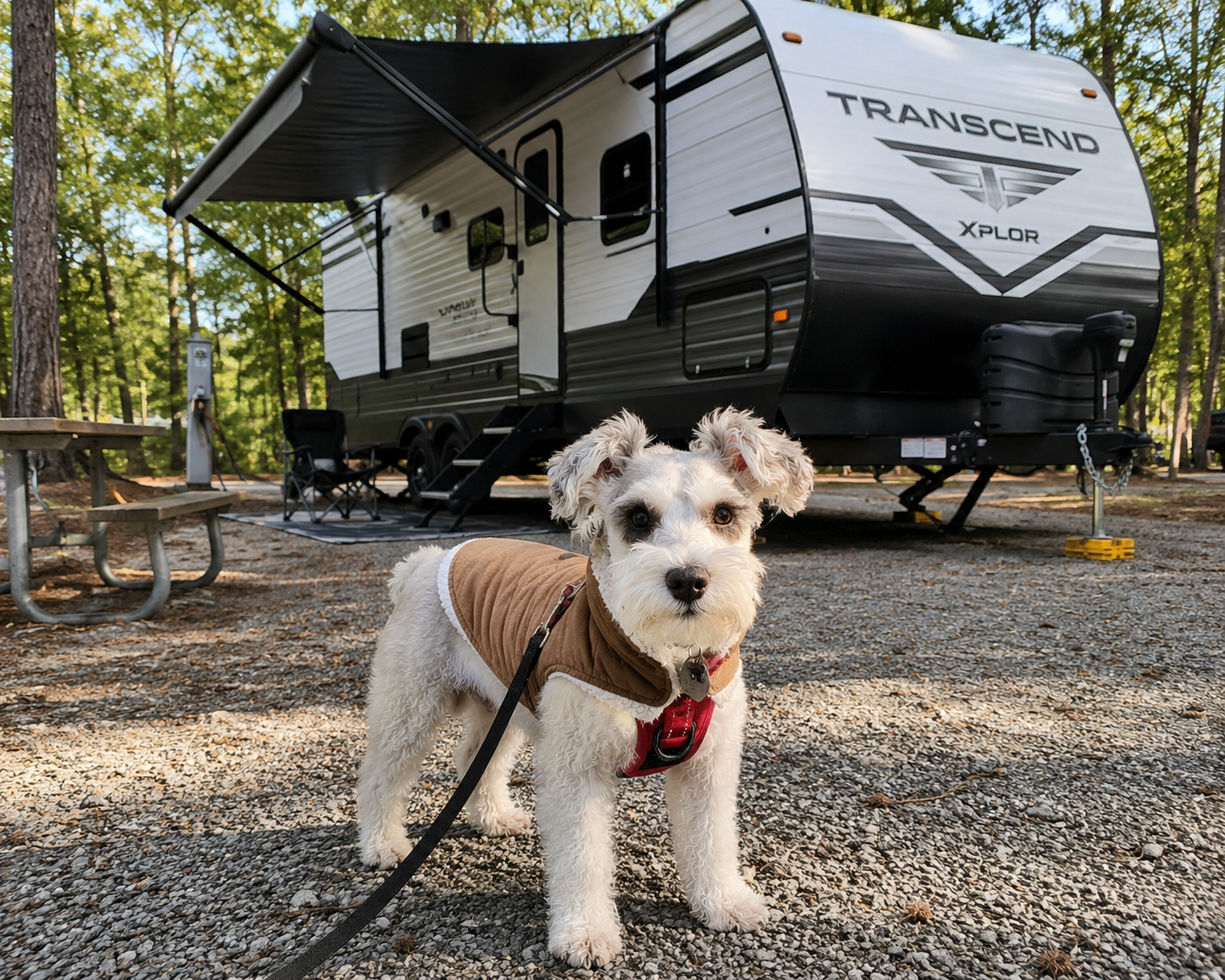
Choosing a campground is one of the biggest decisions we make when planning a travel trailer trip. A campground can look wonderful in photos, but that does not necessarily mean it will work well for our family, our trailer, and our Miniature Schnauzer, Angel.
Over time, we’ve learned that choosing the right campground involves much more than comparing pools, playgrounds, or scenic views. We look at the practical details first: pet policies, campsite dimensions, hookups, location, walking areas, campground layout, and whether the overall environment fits the type of trip we’re planning.
We’ve also learned that the campground with the longest amenity list is not always the campground we would choose. Sometimes a simpler campground in the right location works much better for our family than a resort-style property farther from everything we want to do.
This is the decision-making process we use when we’re trying to narrow several campground options down to the one that makes the most sense for a particular trip.
Affiliate Disclosure: This post may contain affiliate links. If you make a purchase, complete a booking or rental, create a qualifying listing, subscribe to a service, or take another qualifying action through one of these links, we may earn a commission at no additional cost to you.
Advertising Disclosure: This website may display advertisements provided by third-party advertising partners, including Google AdSense. Advertising helps support Travelers and a Schnauzer and allows us to continue providing free travel resources, destination guides, and planning tips for our readers.
Our Quick Answer: What Matters Most to Us?
When we’re deciding how to choose a dog-friendly campground, we usually evaluate our options in roughly this order:
- Will the campground allow Angel under its current pet policies?
- Will the campsite comfortably accommodate our travel trailer and vehicle?
- Are the available hookups appropriate for the trip?
- Does the campground’s location make sense for what we want to do?
- Does the campground appear clean, well maintained, and practical for walking our dog?
- Are the amenities actually useful for our family?
- Do recent reviews reveal recurring concerns we should investigate?
If a campground fails one of the first few questions, an impressive pool, activity schedule, or beautiful view usually isn’t enough to move it back to the top of our list.
That approach helps us focus on how the campground would actually function during our trip rather than how impressive the property looks in a list of amenities.
Choosing a Campground Isn’t the Same as Checking a Reservation
We use two different processes when planning a campground stay.
This article covers the shortlisting stage—how we decide which campground fits a particular trip.
Our separate campground booking checklist begins after we have narrowed down the choices and are ready to verify the details before reserving.
For our reservation-stage process, see Campground Booking Checklist: What We Check Before Reserving a Site:
Before we reach that point, we may have several campground options in front of us.
Instead of asking only, “Does this campground have what we need?” we ask a slightly different question:
“Which of these campgrounds makes the most sense for this particular trip?”
That distinction has helped us make better campground choices.
We Start With the Purpose of the Trip
Before comparing campgrounds, we think about what we’re actually planning to do.
Some trips are mostly about camping. We may expect to spend plenty of time relaxing at the campsite, walking around the campground, cooking outside, and enjoying the property itself.
Other trips are completely different. The campground is mainly our home base while we explore a mountain town, scenic area, historic destination, state park, or nearby attraction.
That changes our priorities.
If we’ll spend most of our days sightseeing, we’re less concerned about having a long list of campground activities. Location and a comfortable campsite become much more important.
If we’re planning to spend most of the weekend at the campground, features such as walking areas, recreation, shade, campsite spacing, and the overall atmosphere carry more weight.
Starting with the purpose of the trip helps us avoid paying for amenities we probably won’t use or choosing a beautiful campground that leaves us driving much farther than necessary.
It also gives us a way to compare campgrounds fairly. A campground that is perfect for a relaxing weekend may not be the best choice for a sightseeing-heavy trip, even if both properties are equally appealing.
Pet Policies Are One of Our First Filters
Because Angel travels with us, we check pet policies very early in the process.
A campground that describes itself as pet-friendly can still have rules that may not work for every traveler or every dog.
Before we get too interested in a property, we look for information about:
- Number of pets allowed
- Breed or size restrictions
- Pet fees
- Leash requirements
- Areas where dogs are prohibited
- Pet-related campground rules
- Designated dog areas when available
We also pay attention to whether a campground appears genuinely practical for people traveling with dogs rather than simply allowing pets.
Features such as convenient waste stations, reasonable walking routes, grassy areas, and designated dog spaces can make everyday campground routines much easier.
Pet policies can change, so we don’t assume information from an older review or a previous visit is still accurate. We confirm the current campground policy before booking.
If you’re preparing for a campground trip with a smaller dog, we share more of what we’ve learned in Camping With a Miniature Schnauzer: Lessons We’ve Learned:
Next We Determine Whether the Site Actually Fits Our Travel Trailer
A beautiful campground does us very little good if the campsite itself does not work for our trailer.
We never want to rely only on a campground’s general description. When possible, we look at the information for the actual site we’re considering.
Important details include:
- Maximum RV or travel trailer length
- Site width
- Pull-through versus back-in configuration
- Room for slide-outs
- Parking space for our vehicle
- Tree placement
- Overhead clearance
- Site surface
- General accessibility into and out of the site
Campground photographs can be helpful, but perspective can make a campsite look larger than it really is.
We prefer reviewing campground maps and individual-site information whenever those resources are available.
We also think about how much usable outdoor space will remain after the trailer and vehicle are parked. A campsite can technically accommodate a travel trailer and still feel cramped once everything is set up.
For us, being able to fit the trailer is only the first question. We also want the campsite to function comfortably for the way we actually camp.
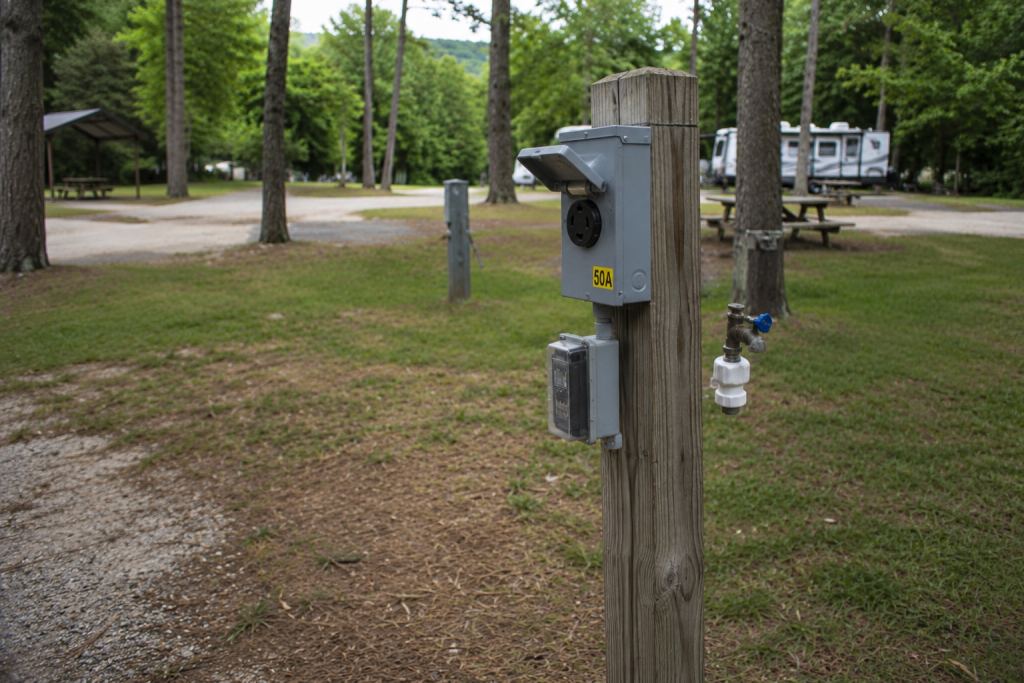
Hookups Matter More to Us Than Fancy Amenities
We’re usually more interested in the campsite itself than in a long list of resort amenities.
When full-hookup sites are available, we tend to favor them because they make camping more convenient for the way our family travels.
Depending on the trip, we look at:
- Electrical service
- Water hookup
- Sewer hookup
- Dump-station access
- Any campground-specific hookup requirements
For a shorter stay, our needs may be different than they would be for several nights.
That is another reason we decide what kind of trip we’re planning before comparing properties. Something that feels important during a longer camping trip may matter much less for a quick weekend getaway.
We would generally rather have the campsite configuration and hookups we want than choose a campground based only on an amenity we may never use.
Location Can Beat Amenities
Location is often one of the biggest deciding factors for us.
We usually don’t choose a campground simply because it looks impressive. We also look closely at what surrounds it and how the location will affect the rest of the trip.
Depending on where we’re going, we may compare its distance from:
- Mountain towns
- State parks
- Scenic drives
- Historic areas
- Hiking opportunities
- Restaurants
- Grocery stores
- Attractions we expect to visit
A campground might offer fewer amenities but save us a significant amount of driving every day.
For a sightseeing-focused trip, that can easily make it the better choice.
We especially think about this when comparing campgrounds around mountain destinations. A relatively short distance on a map doesn’t always translate into a quick drive, so we consider the campground’s actual location and surrounding roads rather than looking only at mileage.
We also think about the inconvenience of repeatedly leaving and returning to the campground. Saving a little driving time each day can make the overall trip feel much easier.
We Think About Angel’s Daily Routine at the Campground
Once a campground passes the basic pet-policy test, we look more closely at what everyday life there might be like with Angel.
Our biggest question is simple:
Will we have practical places to walk her?
Comfortable Walking Areas
Quiet campground roads, walking paths, grassy areas, or designated pet areas can make morning and evening walks much easier.
We don’t need elaborate dog amenities. We mainly want reasonable places where we can take Angel outside throughout the day.
Manageable Vehicle Traffic
Some campground roads stay busy with arriving RVs, golf carts, vehicles, bicycles, and pedestrians.
We pay attention to the campground layout because calmer areas can make dog walks much easier to manage.
Shade
Shade becomes more important during warmer trips.
A site with mature trees or a shaded area can be more comfortable than a completely exposed campsite, although we still have to balance shade with tree placement and travel trailer clearance.
Clean Grounds
Cleanliness affects more than appearance.
We prefer campground environments where the roads, common areas, pet areas, and individual campsites appear well maintained.
Noise Level
Every campground has its own personality.
Some are active, social, and filled with family activities. Others are quieter places where campers mostly relax at their sites.
Neither atmosphere is automatically better.
We simply consider which one fits the trip we’re planning and what is likely to work comfortably for Angel.
At this stage, we’re evaluating whether the campground layout would make Angel’s normal routine practical. Our actual campground safety routines are something we handle separately when we stay.
For more on that part of camping with Angel, see How We Keep Our Schnauzer Safe at Campgrounds:
Amenities Have to Earn Their Place on Our List
It’s easy to get distracted by amenities while campground shopping.
Pools, game rooms, dog parks, playgrounds, organized activities, camp stores, and recreation areas all sound appealing.
We try to separate amenities that will genuinely improve the trip from nice features that we probably won’t use.
For our family, practical amenities may include:
- Walking trails or paths
- Convenient dog-walking areas
- Camp store
- Laundry facilities for longer stays
- Reliable cell reception
- Wi-Fi when needed
- Family recreation areas
- Clean restroom facilities when relevant
For another family, the priority list could look completely different.
That’s why we don’t believe there is one perfect campground for everyone.
The goal is to find the campground that best supports the trip you’re actually taking.
A pool may be valuable on a campground-focused summer weekend. The same pool might have almost no influence on our decision if we plan to leave early each morning and spend the day exploring.
We Look for Patterns in Reviews, Not One Bad Comment
Reviews are one of the tools we use while comparing campground options.
We pay particular attention to comments from RV travelers, families, and pet owners because those experiences may highlight practical issues relevant to the type of trip we’re planning.
Things we watch for include repeated mentions of:
- Site condition
- Cleanliness
- Noise
- Staff interactions
- Internal road condition
- Internet or cellular service
- Campsite spacing
- Pet friendliness
- Ease of getting RVs into sites
One negative review does not necessarily change our opinion.
Travel experiences are subjective, and almost every campground will eventually receive criticism.
What gets our attention is a pattern.
If several recent guests independently mention the same issue, we usually investigate that point more carefully before making a reservation.
We use reviews to identify questions—not as a substitute for checking important information with the campground itself.
We Compare Guest Photos With Official Photos
Official campground photographs can be useful, but we like seeing the property from more than one perspective when possible.
We may look at:
- Campground maps
- Recent guest photographs
- Satellite or map views
- Social media photographs
- Video campground tours
These can help us understand how sites are spaced, how wooded or exposed an area appears, what internal roads look like, and whether the campground’s overall setting matches what we’re expecting.
This type of research can also help us notice things that are difficult to understand from a campground description alone.
For example, we may be able to get a better sense of whether sites are tightly grouped together, whether roads look narrow, or whether a campground is heavily wooded.
We still remember that user-generated photographs and videos may be old, so we use them for context rather than treating them as the final source for current campground policies, amenities, or site conditions.
We Separate Our Non-Negotiables From Our Preferences
This is probably one of the most useful changes we’ve made in our campground search process.
Not everything carries the same importance.
For us, the decision may look something like this:
| Priority | What We’re Evaluating |
|---|---|
| Non-negotiable | Current pet policy works for Angel |
| Non-negotiable | Site can accommodate our travel trailer |
| High priority | Appropriate hookups for the trip |
| High priority | Convenient location |
| High priority | Practical dog-walking environment with manageable campground traffic |
| Preference | Shade |
| Preference | Recreation amenities |
| Preference | Camp store |
| Preference | Extra campground activities |
This keeps us from rejecting an otherwise excellent campground because it lacks something we really didn’t need.
It also prevents an impressive amenity from distracting us from a genuine problem with the site, location, hookups, or pet rules.
When we find ourselves comparing two very different campgrounds, returning to this priority list usually makes the decision clearer.
How We Narrow Two Similar Campgrounds Down to One
Sometimes two campgrounds both meet our basic requirements.
That is when we stop counting amenities and start comparing how each campground would affect the actual trip.
We ask ourselves:
- Which location reduces unnecessary driving?
- Which campsite appears easier for our travel trailer?
- Which campground gives us better options for walking Angel?
- Which campground fits the purpose of this trip?
- Which campground’s recent information gives us fewer unanswered questions?
- Are we paying extra for amenities we probably won’t use?
- Which option will make the overall trip easier?
This usually makes the decision much simpler.
If we’re still undecided, location, campsite quality, and the practicality of the campground for Angel tend to matter more to us than an extra recreation feature.
Using Campground Booking Platforms as Part of the Research
Booking platforms can be useful for discovering and comparing campground options, but we still verify important policies and campground details before finalizing a reservation.
One campground-booking option readers may want to consider is Campspot.
Campspot campground booking (paid link):
https://www.awin1.com/cread.php?awinmid=22326&awinaffid=2934315
We treat a booking platform as one part of the research process rather than the only source of information.
No matter where a reservation is made, we recommend reviewing the specific campground’s current information carefully. Pet policies, campsite availability, fees, hookups, cancellation terms, and other requirements can change.
Our Campground Red Flags
Sometimes deciding where not to stay is just as useful as deciding where to stay.
A campground moves down our list when important information is difficult to confirm or when several concerns appear together.
Things that make us research further include:
- Unclear pet policies
- Site dimensions that are difficult to verify
- Repeated comments about tight RV access
- Numerous recent cleanliness concerns
- Consistent reports of excessive noise
- Uncertainty about vehicle parking
- Few practical areas for walking a dog
- Large differences between newer guest photos and promotional photos
None of these automatically proves that a campground is bad.
They simply tell us we need more information before committing to a reservation.
Sometimes we can resolve a concern by reviewing the campground’s current information or contacting the property. Other times, we decide there are enough alternatives that choosing another campground makes more sense.
What We Do After Choosing the Campground
Once we’ve selected the campground, our focus shifts from comparison to preparation.
That’s when we verify the reservation details, prepare the travel trailer, organize Angel’s supplies, and make sure we have what we need for the trip.
For the packing side of campground preparation, see Camping Checklist for Families With Dogs: The System We Use for Every Trip:
We also use a separate travel-day routine so we’re not trying to remember everything while getting out the door.
Our Travel Day Routine With Angel: From Breakfast to Check-In:
For emergency preparation, our Pet Travel Emergency Kit Checklist: What We Keep Ready for Angel covers the supplies we think about before traveling:
Each of those steps happens after the campground-selection process. Keeping the decision, booking, packing, travel-day, and campground routines separate helps us stay organized without trying to handle everything at once.
What We’ve Learned From Camping With Angel
The biggest lesson we’ve learned is that the “best” campground on paper isn’t always the best campground for our family.
A campground can have dozens of amenities and still be inconvenient for the kind of trip we’re planning.
Another property may be simpler but give us a comfortable campsite, convenient location, good walking areas for Angel, and easy access to everything we want to explore.
Those are often the places that work best for us.
We’ve also become much less impressed by long amenity lists than we used to be. Once we know what the trip is supposed to accomplish, it becomes easier to recognize which features will actually matter.
If you’d like examples of campgrounds that have worked well for our family, we share several in 4 Dog-Friendly Campgrounds We’ve Loved Visiting with Our Schnauzer:
Frequently Asked Questions
What should you look for when choosing a dog-friendly campground?
Start with the campground’s current pet policy, then consider the campsite layout, practical walking areas, campground traffic, cleanliness, shade, location, and overall environment. A property that permits dogs is not necessarily equally convenient for every dog-owning family.
How far in advance should you book a campground?
It depends on the destination, season, campground, and campsite type. Popular destinations and high-demand dates may require more advance planning. We prefer researching early enough that we still have several reasonable campsite options rather than being forced to choose from whatever remains.
Should campground location or amenities matter more?
For us, that depends on the purpose of the trip. If we plan to spend most of our time sightseeing, location usually carries more weight. If the campground itself is the focus of the trip, recreation and on-site amenities become more important.
Are full-hookup campsites worth considering?
They can make campground stays more convenient, particularly when they fit the way a family prefers to camp. We tend to favor full-hookup sites when they are available, but another camper may place more importance on location, campsite size, price, scenery, or other features.
How can you tell if an RV campsite is large enough?
Review the campground’s stated RV-length limits and individual site information whenever available. Also consider slide-outs, tow-vehicle parking, usable outdoor space, trees, overhead clearance, and other obstacles rather than looking only at trailer length.
What makes us eliminate a campground early in our search?
The quickest reasons are usually a pet policy that does not work for Angel or a campsite that does not comfortably fit our travel trailer. After that, unclear site information, poor location for the trip, or several recurring concerns may cause us to look at other options.
Should campground reviews determine where you stay?
We use reviews as one part of the decision rather than the deciding factor. Repeated recent comments usually matter more to us than one unusually positive or negative review. Important policies and reservation details should still be confirmed directly with the campground.
How do you know whether a campground is truly practical for dogs?
We look beyond whether dogs are simply permitted. Practical walking areas, manageable campground traffic, clean grounds, shade, clearly stated pet rules, and convenient pet amenities can all make a campground easier to enjoy with a dog.
Final Thoughts
Choosing a campground takes us more time than simply finding an available campsite, but that research has become an important part of how we plan travel trailer trips.
We start with the things that truly matter: Angel must be welcome, the travel trailer needs to fit comfortably, and the campground needs to work with the purpose of the trip.
From there, we compare location, hookups, walking areas, campsite environment, recent information, and amenities.
We’ve found that this approach keeps the decision manageable.
Instead of searching for a campground that has everything, we’re searching for the campground that has the right things for this trip.
That distinction has made campground planning much easier for our family.
Travel & Camping Disclaimers
Travel Information Disclaimer: Travel information is provided for general planning purposes only. Regulations, policies, pet requirements, availability, admission fees, weather conditions, and operating hours may change. We recommend confirming current information directly with the applicable business, attraction, campground, airline, or government agency before traveling.
Accuracy Notice: We make every effort to provide accurate and up-to-date information. However, travel policies, operating hours, pet rules, reservation procedures, pricing, and other details may change without notice. Always verify important information directly with the official provider before making travel plans.
Accommodation Notice: Property amenities, pet policies, fees, availability, and reservation requirements may change over time. Always review the property’s official listing or contact the owner directly before booking to confirm current details.
RV & Camping Disclaimer: Safe RV operation and campground use require proper planning, equipment maintenance, and adherence to manufacturer recommendations and campground regulations. Always follow applicable safety procedures and consult qualified professionals whenever necessary.
Safety Disclaimer: Every travel situation is unique. Always exercise good judgment, follow posted rules, comply with local laws, monitor weather conditions, and prioritize the safety of yourself, your family, and your pets. Travelers and a Schnauzer is not responsible for decisions made based on the information contained in this article.
Outdoor Recreation Disclaimer: Outdoor recreation involves inherent risks that may include changing weather, wildlife encounters, uneven terrain, and other natural hazards. Always prepare appropriately, carry necessary safety equipment, follow park regulations, and evaluate conditions before participating in outdoor activities.
Pet Travel Disclaimer: Every pet has different needs, abilities, and comfort levels while traveling. Evaluate your dog’s health, temperament, and travel readiness before each trip, and verify current pet policies with transportation providers, accommodations, attractions, and campgrounds before departure.
Product Recommendation Notice: Products recommended throughout this article are selected because we believe they may be helpful for families traveling with their dogs. Recommendations are based on our experiences where applicable, general travel knowledge, product research, and suitability for the topic. Readers should evaluate products to determine what best meets their individual needs.
Product Information Disclaimer: Product features, specifications, availability, warranties, and manufacturer recommendations may change over time. Always review the manufacturer’s official information before purchasing or using any product discussed on this website.
External Links Disclaimer: This article may contain links to third-party websites for your convenience. Travelers and a Schnauzer is not responsible for the content, availability, accuracy, or privacy practices of external websites. Readers should review the policies and terms of any website they choose to visit.
Leave a Reply