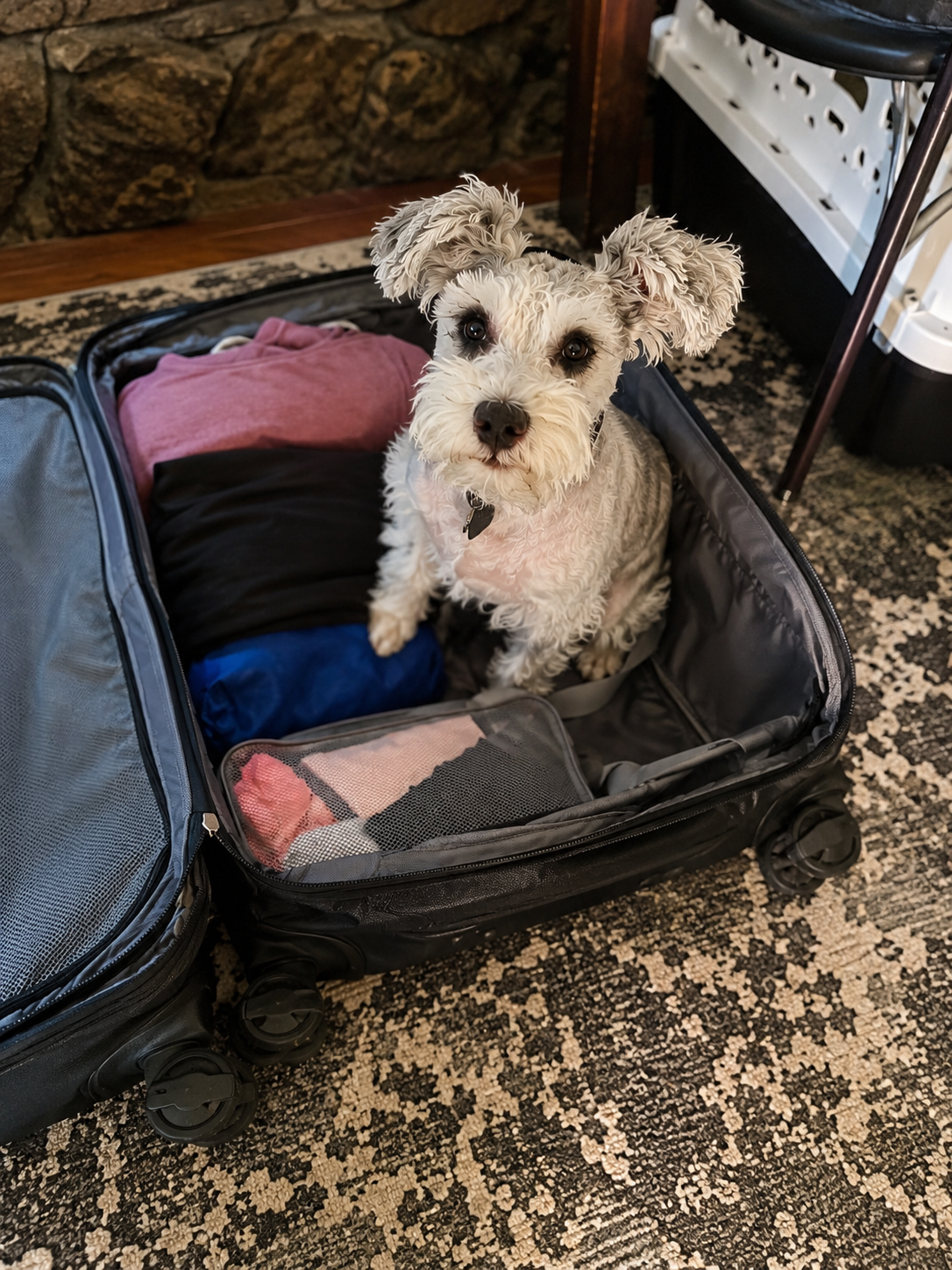
Travel days with Angel start well before we pull out of the driveway. We plan around check-in, give her breakfast early, and finish loading before bringing everyone outside. Once we leave, we allow time for breaks so Angel can walk, drink, and spend a little time out of the SUV.
Our summer trip to Beech Mountain, North Carolina, is a good example. We rented a cabin through Vrbo, left a little before lunchtime, and arrived around check-in. The drive took about five hours before stops, and the day went smoothly. We could go straight to the rental instead of finding somewhere to wait with a loaded vehicle.
Here is how that day unfolded, from Angel’s breakfast to getting everyone settled into the cabin.
Affiliate Disclosure: This post may contain affiliate links. If you make a purchase, complete a booking or rental, create a qualifying listing, subscribe to a service, or take another qualifying action through one of these links, we may earn a commission at no additional cost to you.
As an Amazon Associate I earn from qualifying purchases.
Advertising Disclosure: This website may display advertisements provided by third-party advertising partners, including Google AdSense. Advertising helps support Travelers and a Schnauzer and allows us to continue providing free travel resources, destination guides, and planning tips for our readers.
Product Recommendation Notice: Products recommended throughout this article are selected because we believe they may be helpful for families traveling with their dogs. Recommendations are based on our experiences where applicable, general travel knowledge, product research, and suitability for the topic. Readers should evaluate products to determine what best meets their individual needs.
We Plan Departure Around Check-In
Before choosing when to leave, we look at the drive time and when we can get into our accommodation. We also account for breaks and consider whether our route will take us through heavier traffic.
For Beech Mountain, leaving a little before lunch worked well. Our estimated drive was about five hours, but we knew our stops would add time. We arrived around check-in and were able to begin settling into the cabin right away.
We do not expect every drive to work out that neatly. Traffic or a longer break can change the arrival time. Planning around check-in gives us a useful starting point, and we keep an eye on our estimated arrival time during the drive.
Arriving hours early would have meant finding something to do while our luggage was still in the SUV. For this trip, we preferred going straight to the cabin when it was ready.
Angel Gets Breakfast Before We Finish Loading
We fed Angel early that morning. That gave her time for her usual morning routine while we finished getting ready and loading the SUV.
Our usual approach is to keep Angel and our daughter inside until the main loading is done. We can carry bags out and organize the vehicle without everyone waiting beside it.
Angel’s final bathroom break happens immediately before we leave, after the bulk of the loading is finished. We try to avoid taking her out and then spending another long stretch carrying bags or finishing tasks around the house.
The exact breakfast time changes with our departure time. We follow this order because it works for Angel; another dog’s feeding needs may be different.
If you are still deciding what to bring, our Family Road Trip Packing Checklist: What We Always Check Before Leaving covers that part of preparation:

We Keep Angel’s Stop Supplies Within Reach
Water and walking supplies need to be easy to reach during the drive. We do not want to move luggage around each time we stop.
We used our Dog Travel Water Bottle (paid link) on this trip. It is especially helpful when we are walking Angel during a stop because we can bring her water along:
We also used our Collapsible Bowls (paid link) during the trip. They give us another way to offer water when we have a place to set a bowl down:
The bottle is particularly useful for our stop routine, but you do not need both options simply because we bring both. Choose what suits the way you offer your dog water and keep it accessible.
Angel’s emergency supplies also stay within reach. Our Pet Travel Emergency Kit Checklist: What We Keep Ready for Angel explains what we carry:
Angel Rode in Our SUV With Her Harness and Seat Belt
For this trip, Angel traveled in our SUV with a seat belt that clipped to her harness.
She spent much of the drive looking around and wanting attention, with short naps in between. She did not sleep through the whole journey, so our travel day included keeping her company as well as giving her breaks outside.
We used our Dog Seat Belt (paid link):
Follow the manufacturer’s instructions and check that any restraint is appropriate for your dog, harness, and vehicle. Our use of this seat belt is not a claim that it provides verified crash protection.
Angel also wore her Personalized ID Tag (paid link) during the trip:
Before your own trip, check that your dog’s identification has current contact information.
For more about the driving portion of our trips, see How We Keep Our Schnauzer Comfortable on Long Drives:
At Parker’s, We Took Turns With Angel
One of our stops was at a Parker’s gas station. We were there for at least 20 minutes.
One of us walked Angel for a bathroom break and offered her water while the other parent and our daughter went inside. When they came back out, we switched. That gave the parent who had stayed with Angel a chance to go inside while Angel had more time to stretch her legs.
Taking turns is a useful part of our routine. Everyone’s break does not have to happen at the same time, and Angel’s walk can continue while we each use the restroom.
We usually stop every few hours and include those breaks in our travel estimate. That makes the estimated driving time only one part of the day’s schedule.
We also used our Portable Power Bank (paid link) during the trip:
Charging supplies belong with the things we can reach during travel rather than underneath our destination luggage.
We Explored the Cabin Before Unloading
When we reached the cabin, one of us walked Angel outside first. Then all of us went inside together.
We looked around the rental, found our rooms, and gave Angel time to walk around before bringing in our bags. Our daughter then stayed with Angel while we unloaded the SUV.
That order worked well for us. We had a chance to see the space together, and someone stayed with Angel while the rest of us carried things inside.
For the property checks we make before settling in, see our Vacation Rental Arrival Checklist: What We Check Before Settling In With Our Dog:
We Kept the First Evening Simple
After unloading and getting everything settled, we picked up food to bring back to the cabin. Angel ate while we did, and she settled in fine on the first night.
We did not add an outing to that arrival day. Getting everyone fed and settled was enough after the drive.
Later in the stay, we came back to the rental for a midday rest and sat on the patio. Having that place to return to gave us a break between outings. It was part of our vacation routine once we were there, rather than another activity squeezed into travel day.
Our Beech Mountain Travel Day at a Glance
| Part of the day | What we did |
|---|---|
| Early morning | Fed Angel and prepared to leave. |
| Before departure | Loaded the SUV, kept stop supplies accessible, and gave Angel her final bathroom break. |
| A little before lunchtime | Left for Beech Mountain. |
| During the drive | Angel looked around, wanted attention, and took short naps. We allowed time for breaks. |
| Parker’s stop | Took turns going inside while someone walked Angel and offered water. We stayed at least 20 minutes. |
| Around check-in | Arrived at the cabin, walked Angel, and explored the rental together. |
| Unloading | Our daughter stayed with Angel while we brought in our bags. |
| First evening | Picked up food, ate at the cabin, and settled in for the night. |
The part of this routine we would repeat is the order: finish loading, give Angel her last bathroom break, allow enough time at stops, and explore the rental before unloading.
On our Beech Mountain trip, that left us ready to settle in when we arrived. We had time to unpack, eat together, and let Angel get comfortable before starting our vacation outings.
Before You Go
Travel Information Disclaimer: Travel information is provided for general planning purposes only. Regulations, policies, pet requirements, availability, admission fees, weather conditions, and operating hours may change. We recommend confirming current information directly with the applicable business, attraction, campground, airline, or government agency before traveling.
Safety Disclaimer: Every travel situation is unique. Always exercise good judgment, follow posted rules, comply with local laws, monitor weather conditions, and prioritize the safety of yourself, your family, and your pets. Travelers and a Schnauzer is not responsible for decisions made based on the information contained in this article.
Pet Travel Disclaimer: Every pet has different needs, abilities, and comfort levels while traveling. Evaluate your dog’s health, temperament, and travel readiness before each trip, and verify current pet policies with transportation providers, accommodations, attractions, and campgrounds before departure.
Accommodation Notice: Property amenities, pet policies, fees, availability, and reservation requirements may change over time. Always review the property’s official listing or contact the owner directly before booking to confirm current details.
Product Information Disclaimer: Product features, specifications, availability, warranties, and manufacturer recommendations may change over time. Always review the manufacturer’s official information before purchasing or using any product discussed on this website.
External Links Disclaimer: This article may contain links to third-party websites for your convenience. Travelers and a Schnauzer is not responsible for the content, availability, accuracy, or privacy practices of external websites. Readers should review the policies and terms of any website they choose to visit.
Leave a Reply