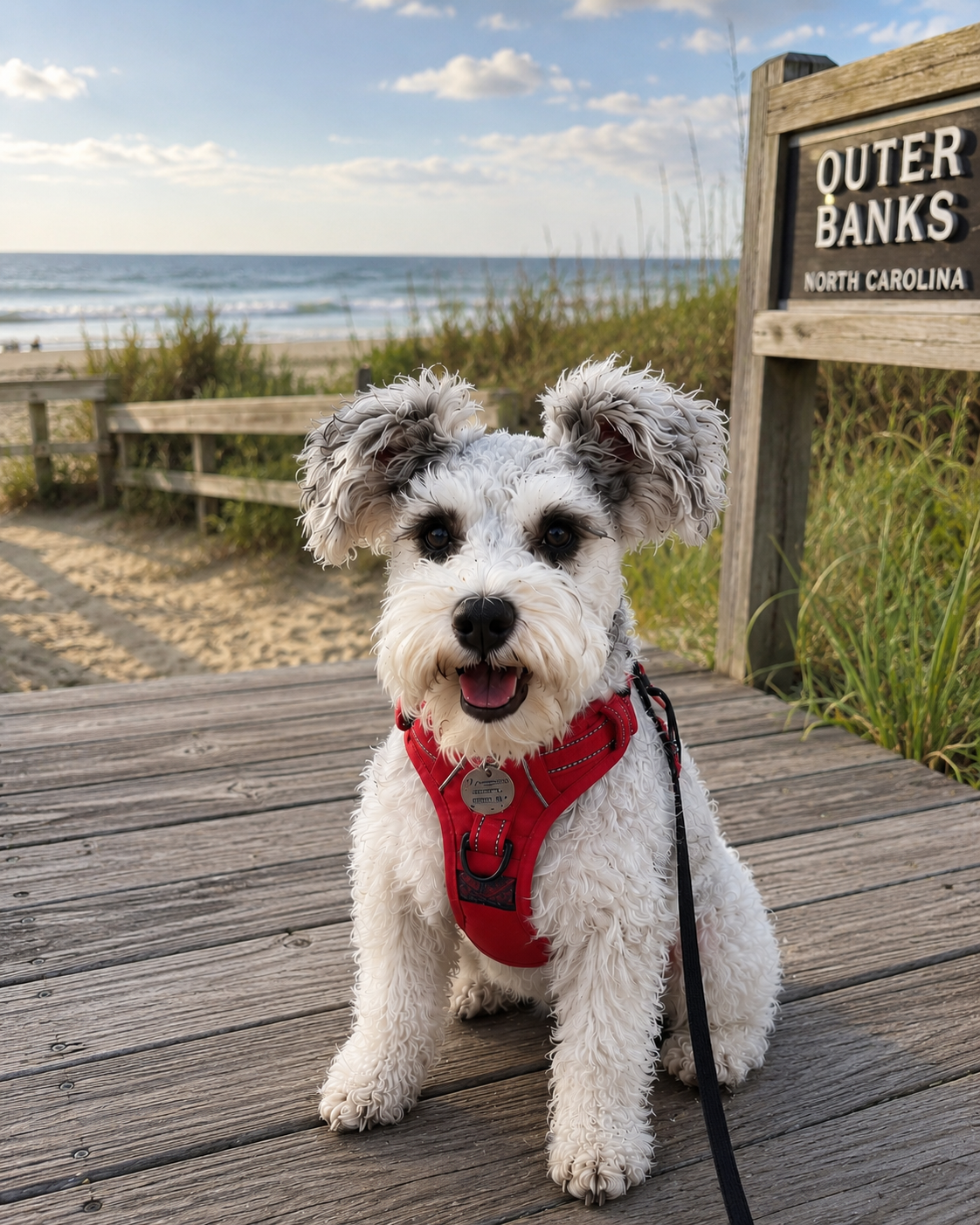
The Outer Banks has been on our list of North Carolina destinations to explore with Angel, our Miniature Schnauzer. We haven’t traveled there with her yet, so this guide is different from the destination articles where we’re able to share exactly what we did, where Angel went with us, and what we would personally do again.
Instead, we’re treating this as our Outer Banks trip-planning guide.
As we’ve researched a future visit, we’ve been looking beyond a simple list of dog-friendly things to do. We want to know which areas could realistically work with Angel, how we would divide our time between beach and non-beach activities, where changing dog rules could affect our plans, and what we would need to confirm shortly before leaving home.
That’s especially important in the Outer Banks because dog policies can vary by town, beach, park, season, time of day, attraction, and individual business.
This is where our planning stands now. Once we actually make the trip, we’ll update this guide with our firsthand experience, what worked well for our family, what we would change, and the places we would personally recommend.
Affiliate Disclosure: This post may contain affiliate links. If you make a purchase, complete a booking or rental, create a qualifying listing, subscribe to a service, or take another qualifying action through one of these links, we may earn a commission at no additional cost to you.
As an Amazon Associate I earn from qualifying purchases.
Advertising Disclosure: This website may display advertisements provided by third-party advertising partners, including Google AdSense. Advertising helps support Travelers and a Schnauzer and allows us to continue providing free travel resources, destination guides, and planning tips for our readers.
Could the Outer Banks Work Well for a Family Traveling With a Dog?
Based on what we’ve researched so far, we think it could.
What interests us most isn’t simply that dogs may be allowed in different places. It’s that the Outer Banks appears to give us several types of activities to work with: beaches, waterfront communities, scenic drives, parks, nature areas, historic areas, and outdoor sightseeing.
That variety matters when we travel with Angel.
We don’t want an itinerary where one activity after another requires leaving her behind. We prefer destinations where we can build a reasonable portion of our day around things she can potentially enjoy with us.
The Outer Banks also requires more advance planning than simply choosing a dog-friendly beach. We would build our trip around four things:
- The current pet rules for the specific community or attraction
- Weather and surface temperatures
- A realistic mix of beach time and other outdoor activities
- Accommodations that work well when traveling with a dog
That planning process is what makes this guide useful to us before we ever arrive.
How We’re Comparing Outer Banks Areas for a Future Trip
Instead of assuming every Outer Banks community would give us the same experience, we’re looking at what role each area might play in our trip.
| Area | Why It’s on Our List | What We’d Confirm Before Going |
|---|---|---|
| Nags Head | Beaches, central location, Jockey’s Ridge, and nearby outdoor areas | Current beach and leash rules, park rules, and weather |
| Kill Devil Hills | Central location for exploring several areas | Seasonal beach restrictions and pet rules |
| Kitty Hawk | Beach access and nearby outdoor areas | Current beach and trail-specific pet rules |
| Duck | Waterfront boardwalk, shopping, and outdoor walking | Boardwalk, beach, and individual business policies |
| Corolla | Beaches, historic areas, and the wild-horse region | Beach regulations, wildlife rules, and dog restrictions |
| Manteo and Roanoke Island | Waterfront walking and historic atmosphere | Property- and attraction-specific pet rules |
| Cape Hatteras area | Scenic coastline and outdoor exploration | Current National Park Service pet regulations and closures |
This is also why we probably wouldn’t choose our accommodation based only on one feature. Where we stay could affect how much driving we do and how easily we can adjust our plans when Angel needs a break.
How We’d Choose Our Outer Banks Vacation Rental
Vacation rentals often work well for the way our family travels with Angel because having our own living space gives us more flexibility than moving through a traditional hotel environment.
For an Outer Banks trip, though, “pets allowed” would only be the beginning of our rental research.
We would compare:
- The property’s specific dog policy
- Pet fees
- Number or size restrictions
- Flooring
- Outdoor space
- Stairs
- Distance from the areas we actually plan to visit
- Whether there is a practical place for Angel’s food, water, and bed
- House rules about leaving pets unattended
- Check-in and check-out requirements
Our What We Look for in a Pet-Friendly VRBO guide goes deeper into the things we normally check before choosing a rental:
We also have a separate guide for researching vacation rentals before committing to a property:
How We Research a Vacation Rental Before Booking:
For families who are comparing Outer Banks rentals, Vrbo can be one place to research individual properties and then review each listing’s current pet rules, fees, amenities, and restrictions before booking.
Browse Vrbo vacation rentals (paid link):
https://www.tkqlhce.com/click-101802584-15736461
We would never assume the entire platform—or every rental in the Outer Banks—welcomes dogs. We would verify the policy of the individual property we were considering.
Exploring Outer Banks Beaches With a Dog
The beach is obviously part of the appeal of an Outer Banks vacation, but this is one area where we would plan carefully.
We wouldn’t treat “the Outer Banks” as if it had one universal dog policy.
Nags Head, Kill Devil Hills, Kitty Hawk, Duck, Corolla, Southern Shores, and other areas can have different rules. Restrictions can also depend on the season or time of day.
That means our approach would be to choose the community first and then confirm its current rules shortly before the trip.
We’d also remember that being allowed on a beach doesn’t automatically mean spending several hours there is the best plan for Angel. Sun exposure, sand temperature, humidity, available shade, and fresh drinking water would affect how long we stayed.
For our family, a shorter early-morning or later-day beach visit could make much more sense than trying to keep Angel on the sand throughout a hot afternoon.
If you’re working on your own dog beach packing list, we have a separate guide based on the things we change when taking Angel to coastal destinations:
Dog-Friendly Beach Trips: What We Pack Differently for Angel:
What We’d Pack for an Outer Banks Beach Day With Angel
Our Outer Banks destination experience is still in the planning stage, but packing for Angel is something we do regularly.
We already know we would want a simple beach setup that lets us handle water, cleanup, shade, and comfort without carrying far more than we need.
We would bring fresh water, Angel’s leash, identification, waste bags, a bowl, towels, shade, and something clean to sit on if we wanted a break from the sand.
Waste bags are one of the basic supplies we keep accessible whenever we’re out with Angel rather than buried in our luggage.
Waste Bags (paid link):
A collapsible bowl is also the type of item that makes sense when we’re trying to keep what we carry relatively compact.
Collapsible Bowls (paid link):
If we planned to sit for a while rather than only taking a beach walk, a waterproof blanket could give us a cleaner place for some of our belongings away from wet sand.
Waterproof Picnic Blanket (paid link):
These aren’t things someone needs to buy specifically for the Outer Banks. They’re simply examples of supplies that may make a dog-friendly beach day easier.
Jockey’s Ridge State Park Is High on Our List
Jockey’s Ridge State Park is one of the Outer Banks stops we’re most interested in seeing.
The landscape is very different from the wooded and mountain areas we’re often drawn to, which is one reason it stands out in our trip research.
For us, the main planning question wouldn’t simply be whether Angel could accompany us. We’d also think about conditions on the dunes.
Exposed sand can become uncomfortable in warm weather, so we wouldn’t automatically schedule this stop for the middle of a hot afternoon simply because that happened to fit our itinerary.
Before visiting, we would check the current North Carolina State Parks information for pet requirements, park hours, weather conditions, and anything else that could affect our visit.
This is a good example of why our Outer Banks itinerary would need flexibility. If conditions didn’t seem comfortable for Angel, we’d rather change the order of our day than force an attraction into a particular time slot.
Duck Gives Us a Different Type of Activity
The Duck Boardwalk interests us because it could provide something we value on dog-friendly trips: an outdoor activity that doesn’t depend entirely on beach time.
A walkable waterfront area gives us another way to experience a destination together.
We could potentially combine a walk with time around the village, shops, outdoor areas, and a meal if we found a restaurant patio that currently allowed dogs.
We would still check the Town of Duck’s current rules as well as the policy of every business we planned to enter or visit.
That’s an important distinction we make when researching dog-friendly destinations. A dog being permitted in a public outdoor area doesn’t mean every neighboring restaurant or shop has the same policy.
Corolla Is on Our List for More Than the Beach
Corolla caught our attention because of its combination of beaches, outdoor spaces, historic areas, and the region associated with the Corolla wild horses.
We’d like to research areas around Corolla Village and the surrounding historic and outdoor attractions before deciding exactly how much time to spend there.
When Angel travels with us, we particularly like areas where we can park and explore on foot rather than constantly getting back into the vehicle between short stops.
The wild horses require a different type of planning.
We would never assume Angel could accompany us on a particular horse-viewing trip or tour simply because an activity takes place outdoors. Wildlife safety, tour-operator rules, vehicle requirements, and dog restrictions would all need to be checked before we decided how to handle that part of the trip.
Regardless of how we eventually see the horses, we would keep our distance, follow all local wildlife requirements, never feed or approach them, and make sure Angel remained under our control.
If Angel couldn’t safely or appropriately participate, we would make that decision before arriving rather than discovering it after we had already built the day’s schedule around the activity.
Roanoke Island and Manteo Could Give Us a Break From the Beach
We wouldn’t want every day of an Outer Banks vacation to revolve around the ocean.
That’s one reason Roanoke Island and Manteo are part of our research.
Waterfront walking areas, historic surroundings, and outdoor spaces could give us another way to explore while keeping the trip varied.
We’re particularly interested in downtown Manteo and the waterfront because those are the types of areas where we might be able to enjoy a slower walk with Angel while still experiencing part of the destination.
As with the other communities, we’d check individual attraction and business policies rather than assuming an entire area is dog-friendly.
NC Highway 12 May Become Part of the Experience
Scenic drives are already something our family enjoys, especially when Angel is traveling with us.
A scenic route works well because we aren’t locked into one long attraction. We can stop, walk for a while, continue driving, take a break when Angel needs one, and adjust the day more easily.
That’s why NC Highway 12 interests us as more than transportation between stops.
If we make the Outer Banks trip we’re currently researching, we would like to use portions of the highway to connect coastal communities and outdoor stops rather than rushing from one major attraction to another.
Rodanthe, Avon, Buxton, Hatteras Island, and the Pea Island area are among the places we would research further as we build the final route.
For longer driving days, we rely on the same general preparation system we use for other family road trips.
Family Road Trip Packing Checklist: What We Always Check Before Leaving:
Cape Hatteras National Seashore Is a Priority Research Stop
Cape Hatteras National Seashore is another place we would like to incorporate if it fits the final route.
What appeals to us is the opportunity to experience a more natural stretch of the Outer Banks while still building much of the day around outdoor sightseeing.
National Park Service locations are also places where we pay close attention to the difference between a park being generally pet-friendly and a dog being allowed in every individual area.
Closures, protected wildlife areas, designated beaches, buildings, and other locations may have different restrictions.
We would review the current National Park Service pet information immediately before visiting and build our stops around where Angel could legally and comfortably join us.
Bodie Island Lighthouse Is on Our Sightseeing List
Bodie Island Lighthouse is another landmark we’d like to see.
When we’re traveling with Angel, an attraction doesn’t necessarily have to allow her inside a building to remain worthwhile. Sometimes the outdoor surroundings and scenery still give us something we can experience together.
Before we make Bodie Island Lighthouse part of the final itinerary, we would confirm exactly where dogs are currently allowed and decide whether enough of the stop could be enjoyed with Angel to make it worthwhile for us.
That is part of the decision-making process that often gets missed when something is simply labeled “dog-friendly” or “not dog-friendly.”
We Would Research Restaurant Patios Individually
Eating out with Angel is something we plan rather than leave entirely to chance.
For the Outer Banks, we would research outdoor dining in the same areas we’re already visiting instead of driving a long distance simply because a restaurant appears on a dog-friendly list.
Duck, Kitty Hawk, Nags Head, Kill Devil Hills, and Corolla are all areas where we would look.
We haven’t personally tested any Outer Banks restaurant patios, so we aren’t going to recommend a particular restaurant based on an old online list.
A patio existing doesn’t automatically mean dogs are currently allowed there.
Before leaving for a restaurant with Angel, we would verify the current policy directly with the business.
If you’re planning meals with your dog on a trip, we share more about what we look for here:
Dog-Friendly Restaurants We Look for While Traveling With Our Schnauzer:
Parks and Nature Areas Could Be Important Backup Activities
Beach trips with a dog are easier when we have alternatives.
Weather can change. Sand can be hotter than expected. A beach may feel crowded. A particular activity may have a restriction we didn’t anticipate.
That’s why we’re also researching parks, preserves, and walking areas such as:
- Kitty Hawk Woods Coastal Reserve
- Nags Head Woods Preserve
- Duck Town Park
- Sandy Run Park
We would check the current rules for the specific trail or area we planned to use because pet access can sometimes vary even within a larger park or preserve.
Having a few alternatives bookmarked before the trip would make it much easier for us to change plans without spending the morning searching for something else to do.
What We Already Know We’ll Pack for Angel
Even though the Outer Banks itself is still a future trip, our core travel setup for Angel doesn’t change dramatically from one trip to the next.
We would bring her regular food, treats, leash, backup leash, identification, bed or blanket, favorite toys, cleanup supplies, water supplies, and emergency essentials.
For days when we expect to walk around for several hours, carrying water specifically for Angel is something we plan for rather than assuming we’ll always find it when we need it.
Dog Travel Water Bottle (paid link):
We also travel with emergency supplies. A compact pet first aid kit can be useful for keeping basic supplies organized, although it does not replace veterinary care when a dog needs professional attention.
Pet First Aid Kit (paid link):
Our full approach to Angel’s emergency supplies is here:
Pet Travel Emergency Kit Checklist: What We Keep Ready for Angel:
And if you’re building a broader dog travel setup, we’ve collected more of the types of accessories we use or consider helpful here:
Travel Accessories We Use for Our Miniature Schnauzer:
How We Would Build a Tentative Outer Banks Itinerary
We don’t have a final itinerary because we haven’t selected dates or accommodations yet, but our research is already showing us how we would probably organize the trip.
Rather than zigzagging across the Outer Banks every day, we would group stops geographically.
One day might focus on the Nags Head area, potentially combining a comfortable period of beach time with Jockey’s Ridge or another nearby outdoor stop.
Another day could concentrate on Duck and Corolla so we could explore the northern communities without repeatedly driving back and forth.
A different day could focus on Manteo and Roanoke Island or head farther south toward Cape Hatteras, depending on where we’re staying, the weather, and how much driving we want to do that day.
The important part for us would be keeping the itinerary flexible.
Angel doesn’t know that something is on our vacation schedule. If the sand is too hot, a location is crowded, weather changes, or she simply needs more downtime, we want enough flexibility to adjust.
What We’d Check Again Right Before the Trip
Some parts of this trip aren’t things we’d research once and consider finished.
Within the last few days before leaving, we would recheck:
- Beach dog regulations for the communities on our itinerary
- Leash requirements
- Park and trail pet policies
- National Park Service closures or restrictions
- Weather forecasts and alerts
- Vacation-rental pet rules
- Restaurant patio policies
- Any attraction-specific restrictions
- Wildlife guidance
- Operating hours for places we plan to visit
That final check is one of the simplest ways to avoid building a day’s plans around outdated information.
What Would Make Us Change Our Plans
One lesson we’ve learned from traveling with Angel is that a technically permitted activity isn’t always the right activity at that moment.
For the Outer Banks, we would change plans if:
- Sand or pavement seemed too hot
- Angel was getting tired
- There wasn’t enough shade
- A beach or walking area was unusually crowded
- Weather conditions changed
- Wildlife restrictions affected access
- The current pet policy differed from what we had found earlier
- A restaurant or attraction could no longer accommodate dogs
Building in alternatives is much easier than trying to force the original itinerary to work.
Why the Outer Banks Is Still on Our Travel List
The more we research the Outer Banks, the more interested we are in eventually experiencing it with Angel.
Our potential itinerary now includes beach time, Jockey’s Ridge State Park, Duck, Corolla, Roanoke Island and Manteo, portions of NC Highway 12, Cape Hatteras National Seashore, and several other outdoor areas.
But the part of our research that has been most useful isn’t simply collecting a longer list of attractions.
It’s understanding how we would put those places together into a trip that actually works with our dog.
We’ve learned from other trips that “dog-friendly” rarely means a dog can go everywhere. Local beach regulations, wildlife protections, seasonal restrictions, restaurant policies, and individual attraction rules can all affect the day.
For now, this article represents our planning rather than firsthand Outer Banks experience.
Once we make the trip, we’ll update it with what actually worked for our family, where Angel was able to join us, what surprised us, what we would do differently, and which places we would personally recommend to another family planning an Outer Banks trip with their dog.
Frequently Asked Questions
Are dogs allowed on Outer Banks beaches?
Dogs are permitted on beaches in several Outer Banks communities under varying rules, but there is not one policy that applies everywhere. Towns may have different leash requirements, seasonal restrictions, or time-of-day rules. We would verify the current regulations for the specific beach we planned to visit shortly before the trip.
Is the Outer Banks a good vacation destination with a dog?
Based on our research, we think it has the potential to work well for the way our family travels because there are beaches, outdoor spaces, scenic areas, and walkable communities to consider. Whether it works well for a particular dog depends on that dog’s needs, the weather, accommodations, and the activities a family chooses.
Which Outer Banks community would we choose with Angel?
We haven’t made that decision yet. We would compare our planned activities, rental options, pet policies, and how much driving each location would require before choosing our home base.
Would we spend every day at the beach?
Probably not. We would mix beach time with waterfront areas, scenic drives, parks, historic areas, and other outdoor sightseeing. That gives us more flexibility if weather or beach conditions aren’t ideal for Angel.
What would we pack for a dog-friendly Outer Banks trip?
We would bring the same core supplies we use on other trips: Angel’s normal food, water supplies, leash and backup leash, identification, waste bags, bed or blanket, favorite toys, cleanup supplies, and emergency essentials. Beach days would add extra attention to shade, fresh water, and sandy-paw cleanup.
Are there pet-friendly vacation rentals in the Outer Banks?
There are individual Outer Banks vacation rentals that permit pets. We would never assume all properties have the same rules, however. Before booking, we would review the specific property’s current pet policy, fees, restrictions, and house rules.
How far ahead would we check dog regulations?
We would research them while planning and then check again shortly before leaving. Rules and temporary restrictions can change, particularly when weather, wildlife, seasonal conditions, or local regulations are involved.
More Dog-Friendly Travel Planning
If you’re planning a coastal trip or vacation-rental stay with your dog, these guides may also help:
Dog-Friendly Beach Trips: What We Pack Differently for Angel:
What We Look for in a Pet-Friendly VRBO:
How We Research a Vacation Rental Before Booking:
Family Road Trip Packing Checklist: What We Always Check Before Leaving:
Pet Travel Emergency Kit Checklist: What We Keep Ready for Angel:
Important Disclosures and Notices
Product Recommendation Notice: Products recommended throughout this article are selected because we believe they may be helpful for families traveling with their dogs. Recommendations are based on our experiences where applicable, general travel knowledge, product research, and suitability for the topic. Readers should evaluate products to determine what best meets their individual needs.
Veterinary Disclaimer: The information provided in this article is intended for general educational and informational purposes only and should not be considered veterinary advice. Every dog has unique health needs. Always consult your licensed veterinarian regarding questions about your pet’s health, medications, allergies, nutrition, or medical care before making changes to your pet’s routine or treatment plan.
Travel Information Disclaimer: Travel information is provided for general planning purposes only. Regulations, policies, pet requirements, availability, admission fees, weather conditions, and operating hours may change. We recommend confirming current information directly with the applicable business, attraction, campground, airline, or government agency before traveling.
Destination Information: Every destination offers unique experiences, seasonal conditions, and local regulations. We encourage readers to verify current information with official tourism organizations, park systems, and local authorities before finalizing travel plans.
Accommodation Notice: Property amenities, pet policies, fees, availability, and reservation requirements may change over time. Always review the property’s official listing or contact the owner directly before booking to confirm current details.
Accuracy Notice: We make every effort to provide accurate and up-to-date information. However, travel policies, operating hours, pet rules, reservation procedures, pricing, and other details may change without notice. Always verify important information directly with the official provider before making travel plans.
Pricing Notice: Prices, fees, discounts, and availability frequently change. Any pricing information discussed is intended as general guidance only. Please verify current pricing directly with the retailer, travel provider, or official website before making purchasing decisions.
External Links Disclaimer: This article may contain links to third-party websites for your convenience. Travelers and a Schnauzer is not responsible for the content, availability, accuracy, or privacy practices of external websites. Readers should review the policies and terms of any website they choose to visit.
Pet Travel Disclaimer: Every pet has different needs, abilities, and comfort levels while traveling. Evaluate your dog’s health, temperament, and travel readiness before each trip, and verify current pet policies with transportation providers, accommodations, attractions, and campgrounds before departure.
Safety Disclaimer: Every travel situation is unique. Always exercise good judgment, follow posted rules, comply with local laws, monitor weather conditions, and prioritize the safety of yourself, your family, and your pets. Travelers and a Schnauzer is not responsible for decisions made based on the information contained in this article.
Outdoor Recreation Disclaimer: Outdoor recreation involves inherent risks that may include changing weather, wildlife encounters, uneven terrain, and other natural hazards. Always prepare appropriately, carry necessary safety equipment, follow park regulations, and evaluate conditions before participating in outdoor activities.
Weather Disclaimer: Weather conditions can change rapidly and may affect travel safety, campground operations, hiking conditions, road access, and outdoor activities. Always review current forecasts and official weather alerts before traveling.
Product Information Disclaimer: Product features, specifications, availability, warranties, and manufacturer recommendations may change over time. Always review the manufacturer’s official information before purchasing or using any product discussed on this website.
Educational Purpose: The information provided throughout Travelers and a Schnauzer is intended for general educational and informational purposes. While we strive to provide helpful and accurate content, readers should use their own judgment and consult appropriate professionals when necessary for their individual circumstances.
Leave a Reply